
Ethanol boiling point vs pressure - calculator
Ethanol always boils at the same temperature, on one condition: the atmospheric pressure must be constant. Meanwhile the weather, and especially altitude, shifts that point by up to several degrees. For home distillers this is not a theoretical number - it is a practical challenge that affects the quality of fractionation and the efficiency of separation.
What should you do? Use our calculator based on the Antoine equation. Enter the atmospheric pressure (check it in a weather app before distilling), and the calculator shows you the boiling point of alcohol under exactly that condition. That way you know which temperature to aim for to separate the fractions precisely, whatever the weather or the altitude.
What is the normal boiling point of ethanol?
Ethanol boils at 78.3 °C at a standard pressure of 1013 hPa (at sea level, “normal” weather). That is the number that appears in every chemistry textbook. In a real home or on a farm, however, the pressure is rarely exactly 1013 hPa, so temperatures can shift by 1-3 °C either way.
The difference may seem small, but for distillation it is crucial. If you want to separate an unwanted fraction, you need to know the exact boiling point of the alcohol. Too high a temperature means you are already collecting tails rather than the main alcohol (hearts) before you have got rid of the unwanted smells. Too low - and the hearts will take too long to distil.
That is why the EQUINOX T-4 WiFi thermometer with an alarm is the answer: it reads the temperature sensor in the liquid, and you know what that temperature should be in your particular atmospheric conditions.
How does atmospheric pressure affect the boiling point?
The lower the pressure, the lower the boiling point. It is a law of physics: liquid molecules need less energy (a lower temperature) to escape as vapour when there is less air pressure on them.
Practical consequences: At low altitude and normal pressure you have ~78.3 °C. But at 800 m above sea level (pressure ~930 hPa), the boiling point drops to about 75 °C. That 3 °C difference changes the whole dynamics of the process. Ethanol evaporates faster, the phases are shorter, and the distillation speed is sometimes harder to control.
Many home distillers are not aware of this. They set their thermometer to a fixed “78 °C” and do not adjust it to the weather. As a result, on a rainy day (lower pressure) the thermometer can mislead by a couple of degrees. Those couple of degrees are enough to collect the fractions wrongly.
The Antoine equation - how does it work in practice?
The Antoine equation is the mathematical route from pressure to temperature. It looks like this:
log₁₀(P) = A − B / (C + T)
Where P is the pressure in millimetres of mercury (mmHg), T is the temperature in degrees Celsius, and A, B, C are constants specific to ethanol (A=8.04494, B=1554.3, C=222.65).
Sounds complicated? In practice you do not have to calculate by hand. That is what the calculator is for. Enter your atmospheric pressure (you can get it from the EQUINOX T-4 thermometer app, a weather station or a digital barometer), and the calculator solves the equation for temperature.
What do you gain? Precision. Instead of blind faith in “always 78 °C”, you work with a number adjusted to the real conditions. That is exactly the difference between amateur work and a serious approach.
Worked example: the difference between 1013 hPa and 980 hPa
Imagine two scenarios: winter with high pressure (1013 hPa) and autumn with a low (980 hPa). Both are realistic conditions.
Scenario 1: Fine weather, pressure 1013 hPa
The boiling point of ethanol is 78.3 °C. You switch on the heating element, the temperature in the column rises, and when you reach 78 °C, distillation starts shortly afterwards. You adjust the power, control the speed, everything runs smoothly.
Scenario 2: Changeable weather, pressure 980 hPa
The boiling point drops to about 76.5 °C. If you watch the thermometer waiting for 78 °C, you will already be in the main distillation. Because of the 1-1.5 °C difference you can lose part of the transition phase, which could contain interesting aromas.
It is not a great tragedy, but it shows why the calculation matters. An experienced distiller always takes the weather into account.
Does a WiFi thermometer help control this parameter?
Not directly. A WiFi thermometer is a temperature sensor that shows you the temperature of the liquid. But if you know the boiling point for your altitude and pressure (thanks to our calculator), you can program it to warn you at exactly the right moment.
The WiFi controllers we offer can set temperature alarms with a resolution of 0.1 °C. This means you can tell the system: “Heat to exactly 76.8 °C, then reduce the power to 30% and hold.” That prevents overheating and using up the fraction you want to keep.
Common mistakes when setting the boiling point
Always using the same temperature
Many people learn that “ethanol boils at 78 degrees” and never change that assumption. In reality you should check the pressure before every distillation. It takes 10 seconds, and the effect on your work is real.
Ignoring altitude
If you live in the mountains or distil in different places, the boiling point changes too. A low-lying area has a different pressure from the foothills or the mountains. Do not ignore it.
Calibrating the thermometer to a fixed value
If your thermometer or controller has a “fixed” boiling point that cannot be changed, you lose flexibility. Good solutions allow adjustment.
Watching only the temperature and ignoring the taste and smell of the distillate
Temperature is one of the signals, but not the only one. In changing conditions there can be small lags between the theoretical boiling point and reality. Always watch how the distillate tastes and smells, alongside monitoring the temperature.
Distillation calculator
Wash, yield, dilution, alcoholmeter correction, sugar scales, column and heating element power, costs - 16 distilling calculators in one place. Enter your data and the result updates live.
⚠️ Approximate values (for education). Results depend on raw material purity, equipment efficiency and conditions - treat them as a starting point, not a standard.
Distilling alcohol is regulated or requires a licence in many countries. Check the regulations in your country before use.
WiFi distillation thermometer - EQUINOX T-4 →Frequently asked questions
Does wine boil at the same temperature as pure ethanol?
No. Wine is a solution (water, ethanol, sugars, acids). Its boiling point will be higher than that of pure ethanol, because water boils at 100 °C. The mixture will boil somewhere between 78 °C (ethanol) and 100 °C (water), depending on the alcohol concentration.
Can I rely on tables alone when distilling?
Tables are a good starting point, but you should always check them against your particular conditions. Atmospheric pressure changes every day, sometimes every hour. That is why calculating before you start is standard practice.
What should I do if the thermometer shows a different temperature from what I expect?
Check the atmospheric pressure (weather app, barometer). If the pressure differs from what you entered in the calculator, the temperature will change too. Recalculate for the real conditions. If the difference is still large, check the sensor calibration.
Does altitude really change distillation?
Yes. Every 100 metres above sea level changes the atmospheric pressure by about 12 hPa, which shifts the boiling point by about 0.4 °C. In the mountains the difference adds up. If you are 500 m higher, that is already ~2 °C.
Summary
The boiling point of ethanol is not a fixed number but a function of atmospheric pressure. Depending on the weather and altitude, it can range between 75 °C and 79 °C. Ignoring this leads to fractionation errors and losses in product quality.
Our calculator based on the Antoine equation lets you quickly determine the exact temperature for your current conditions. It is a useful tool especially for beginners, but also for experienced distillers who want to work more precisely.
If you are interested in automatic temperature control, take a look at our WiFi thermometers and distillation controllers. They let you automate the whole process, but they demand one thing: knowing the temperature to heat to. The calculator gives you that knowledge in seconds.
Important: Home distillation of alcohol in Poland is subject to legal restrictions, and it is regulated in many other countries too. Before you start, check the local regulations and tax requirements.
See also: all distillation calculators · heating element power and column operating power. An accurate reading comes from a WiFi thermometer from the shop.
More questions about boiling points
What is the optimal distillation temperature for spirit?
The boiling point of a water-ethanol mixture depends on atmospheric pressure and the composition of the liquid. Pure ethanol boils at about 78.4 °C and water at 100 °C; distillate is collected in the range between these values. Changes in atmospheric pressure (e.g. a storm front) can shift the boiling point by several degrees, which is why precise temperature control - e.g. with a WiFi thermometer and a DS18B20 sensor - matters here.
At what temperature is it best to distil spirit?
Ethanol boils at 78.37 °C at a pressure of 1013 hPa (sea level). A fermented wash is a mixture of ethanol and water, so the vapour temperature depends on the alcohol concentration in the wash - the higher the concentration, the closer to 78 °C. Local atmospheric pressure shifts this value: at higher altitude the boiling point is lower. That is exactly what the calculator on this page works out.
At what temperature do the tails start?
Tails (the last fraction) start when the column head temperature, after the stable hearts run (about 78.3-78.5 °C at normal pressure), begins to climb above about 78.5 °C. The earlier fractions contain more volatile compounds - acetaldehyde (21 °C) and methanol (64.7 °C) - which boil below ethanol. The exact boundary depends on the composition of the wash and the current atmospheric pressure, which is why precise real-time temperature measurement, e.g. with a DS18B20 sensor, is crucial here.
Up to what temperature should you collect distillate?
Collection usually ends at around 96-98 °C at normal pressure - above this limit the alcohol concentration in the vapour drops sharply in favour of water. As pressure falls (higher altitude), this value is correspondingly lower. Real-time temperature monitoring lets you pinpoint this moment without constant manual measurement.
How does the boiling point of alcohols change?
The boiling point depends on the type of alcohol and the pressure. Ethanol boils at 78.4 °C (101.3 kPa), methanol at 64.7 °C, propanol at 97.2 °C. Lower pressure (e.g. high altitude) lowers the boiling point of each of them. In ethanol-water mixtures the boiling point lies between the values of the components and rises as the ethanol concentration falls.
What temperature should you distil alcohol at?
In an ethanol-water system at atmospheric pressure, ethanol-rich vapour comes off from about 78-80 °C; as the ethanol is used up, the temperature gradually rises towards 100 °C (water). The exact value depends on the current concentration and pressure - which is why continuous measurement with a temperature sensor (e.g. a DS18B20 with online logging) lets you follow the change in fraction composition as you go.
What are the boiling points of alcohol?
The boiling point depends on the type of alcohol and the atmospheric pressure. Ethanol (96%) boils at 78.37 °C at 1 atm; methanol at 64.7 °C; isopropanol at 82.6 °C. In water solutions (wash, liqueurs) the boiling point rises as the concentration falls - a mixture of ~10% vol. ethanol boils at about 91-92 °C. Lower pressure proportionally lowers the boiling point of each of them.
What are the distillation temperatures of alcohol?
Pure ethanol boils at 78.4 °C at a pressure of 1013 hPa, and water at 100 °C. The azeotrope (about 95.6% ethanol by mass) boils at 78.2 °C. The boiling point of the mixture depends on the alcohol concentration: a wash of about 10% vol. boils at about 92 °C, and as the ethanol runs out, the temperature rises towards 100 °C. Methanol boils at 64.7 °C, and higher (fusel) alcohols above 97 °C. The boiling point also changes with pressure, by about 1 °C for every 35-40 hPa. That is why it is worth converting the reading from the sensor in the boiler or column (e.g. a DS18B20) in the calculator.
Related guides
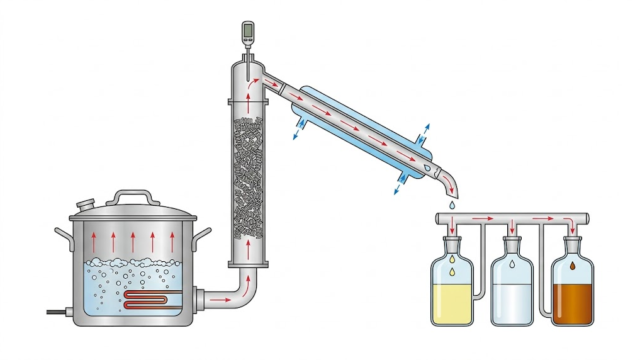 Distillation
The distillation process step by step: how distillation works and answers to common questions
The distillation process step by step: stages, fraction temperatures, heads, hearts and tails, the azeotrope and methanol - answers to common questions.
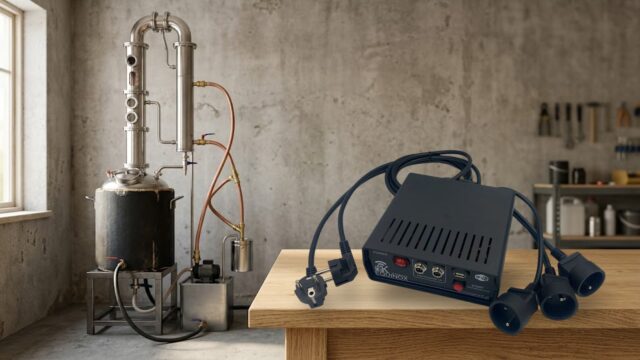 Distillation
WiFi thermometer upgrade: how to turn a thermometer into a column controller
WiFi thermometer upgrade: the add-on module turns an EQUINOX thermometer into a column controller. What stays, what is added and when the RK.10 is better.
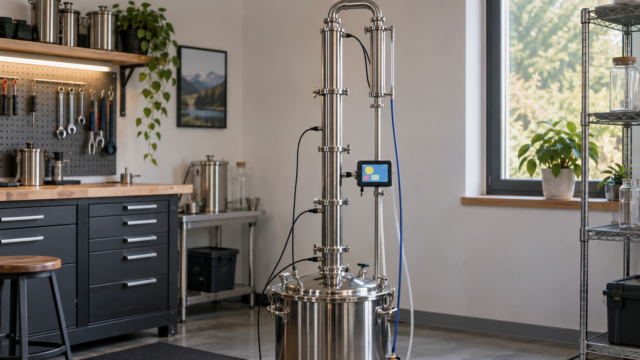 Distillation
Reflux column thermometer: how many sensors and where to fit the probes
Reflux column thermometer: four probes (boiler, buffer, plate, condenser), what each shows, alarms and a pressure sensor with boiling point correction.