
How much spirit from 1 kg of sugar? Wash yield calculator
1 kg of sugar gives at most 0.648 litres of pure ethanol (fermentation stoichiometry), and realistically - after fermentation and distillation losses - about 0.5-0.55 litres of 100% alcohol, i.e. about 1-1.1 litres of 50% distillate. The calculator below works out the yield for your amount of sugar, efficiency and target strength.
Distillation calculator
Wash, yield, dilution, alcoholmeter correction, sugar scales, column and heating element power, costs - 16 distilling calculators in one place. Enter your data and the result updates live.
⚠️ Approximate values (for education). Results depend on raw material purity, equipment efficiency and conditions - treat them as a starting point, not a standard.
Distilling alcohol is regulated or requires a licence in many countries. Check the regulations in your country before use.
Measure temperature precisely - EQUINOX T-4 thermometer →Where this result comes from - chemistry, not guesswork
Alcoholic fermentation follows the Gay-Lussac equation: sucrose, after inversion, gives glucose and fructose, which break down into ethanol and carbon dioxide. The mass balance sets a hard limit: 1 kg of sucrose → max. 0.511 kg of ethanol, i.e. 0.648 l of pure alcohol (ethanol density 0.789 kg/l at 20 °C). Physically you cannot get more - any recipe promising more breaks chemistry, not a record.
From theory, these take their share:
- fermentation - yeast uses part of the sugar for its own metabolism and biomass (usually 5-10%),
- distillation - losses in the foreshots, the tails and what stays in the equipment (another 5-10%).
Hence the practical efficiency of the whole process is 75-90% - set it with the slider in the calculator.
Table: how much alcohol from sugar (85% efficiency)
| Sugar | Pure alcohol (100%) | Distillate 50% | Distillate 40% |
|---|---|---|---|
| 1 kg | ~0.55 l | ~1.1 l | ~1.4 l |
| 2 kg | ~1.10 l | ~2.2 l | ~2.8 l |
| 3 kg | ~1.65 l | ~3.3 l | ~4.1 l |
| 5 kg | ~2.75 l | ~5.5 l | ~6.9 l |
| 6 kg | ~3.30 l | ~6.6 l | ~8.3 l |
| 10 kg | ~5.51 l | ~11.0 l | ~13.8 l |
And how much spirit from a litre of wash?
It depends only on how much sugar was in the wash. The classic “1410” wash (1 kg of sugar, 4 l of water, 100 g of yeast) has about 20 °Blg (practically the same as 20 °Plato, SG ≈ 1.083) - 10 l of such a wash (about 2.2 kg of sugar) gives about 1.2 l of pure alcohol, i.e. ~2.4 l of 50% distillate. If you know the volume and °Blg of your wash, convert the sugar in the BLG calculator and enter the result here.
Frequently asked questions
How much spirit from 10 kg of sugar?
About 5.5 l of pure alcohol, i.e. ~11 l of 50% distillate or ~13.8 l at 40% (at 85% efficiency).
Why did I get less than the calculator says?
Most often: incomplete fermentation (too cold, too weak yeast, too sweet a wash), stopping the distillation too early or losses in the foreshots. Check the °Blg before and after fermentation - the difference shows how much sugar the yeast actually converted.
Does turbo yeast increase the yield?
It does not increase the maximum (chemistry is unforgiving) - it shortens the time and tolerates high alcohol concentrations better, so fermentation finishes more often. That raises the efficiency, not the theoretical limit.
Is home distillation legal?
In Poland, producing ethyl alcohol is subject to excise law, and it is regulated in many other countries too. This content is educational and technical; check the law that applies to you before doing anything.
Work out the costs and the rest of the process too
Yield is one thing, your wallet another - the distillation cost calculator breaks the cost of a litre down into sugar, yeast and electricity. You will find all the calculators in the distillation calculator.
More questions
How much spirit will 10 kg of sugar give?
10 kg of sugar dissolved in about 50 l of water gives a wash of about 10-12% vol. alcohol. The theoretical fermentation yield is ~51 g of ethanol per 100 g of sugar; in practice 45-48 g (losses to yeast and evaporation). The final result depends on the yeast strain, fermentation temperature (optimum 18-24 °C) and the quality of the raw material.
How long does a sugar wash need to stand?
A sugar wash usually ferments for 7-14 days at 18-24 °C. The time depends on the yeast strain, the temperature (lower = slower, but a cleaner profile) and the density of the wash. Readiness is best confirmed with a hydrometer - when the reading stops falling for 2-3 days, fermentation has finished. Continuous temperature monitoring helps avoid stalling the yeast in surroundings that are too cold or too hot.
How much alcohol from 1 kg of sugar?
1 kg of sucrose theoretically produces about 0.51 l of pure ethanol (96%). In practical fermentation - with healthy yeast, proper nutrients and a stable temperature of 18-24 °C - the yield is 85-92% of the theoretical value, which gives about 0.43-0.47 l of pure alcohol. The result depends on the yeast strain, the pH of the wash and temperature control; swings above 25 °C noticeably lower the yield.
How much alcohol do you get from 1 kg of sugar?
1 kg of sugar realistically gives about 0.5-0.55 l of pure alcohol (100%), i.e. about 1-1.1 l of 50% distillate or about 1.4 l at 40% (at 85% efficiency). You cannot get a litre of spirit from a kilogram of sugar, because fermentation chemistry limits it. How much you actually get depends on the efficiency of the process (75-90%). What counts is whether fermentation finished (wash at 18-22 °Blg, temperature 18-25 °C) and the losses in the foreshots and tails.
How much spirit comes from 1 kg of sugar?
1 kg of sugar theoretically gives max. 0.648 l of pure ethanol, and realistically about 0.5-0.55 l of 100% alcohol, i.e. about 1-1.1 l of 50% distillate or ~1.4 l of 40% distillate (at 85% efficiency). The result depends on whether fermentation has finished. A wash of 18-22 °Blg (not above ~25 °Blg) helps, along with a steady temperature of 18-25 °C, which is easy to keep an eye on with a WiFi thermometer. Losses in the foreshots and tails matter too. In Poland, making distillate without being entered in the register is illegal, and distilling is regulated in many other countries too; check the law where you live.
Related guides
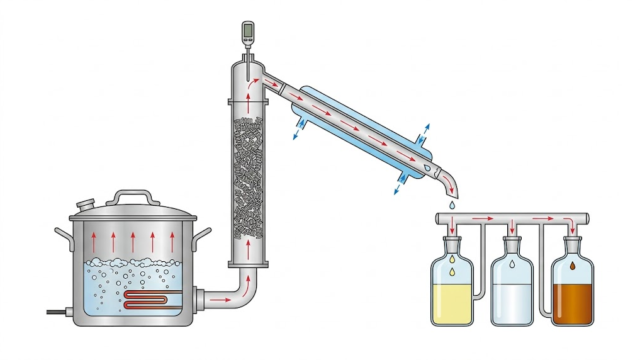 Distillation
The distillation process step by step: how distillation works and answers to common questions
The distillation process step by step: stages, fraction temperatures, heads, hearts and tails, the azeotrope and methanol - answers to common questions.
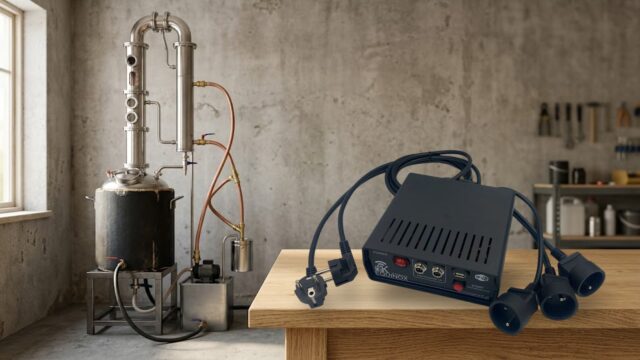 Distillation
WiFi thermometer upgrade: how to turn a thermometer into a column controller
WiFi thermometer upgrade: the add-on module turns an EQUINOX thermometer into a column controller. What stays, what is added and when the RK.10 is better.
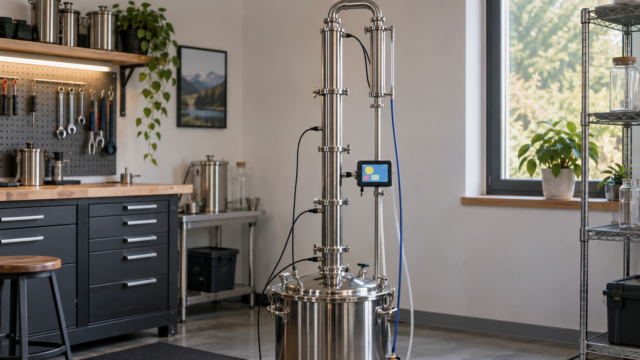 Distillation
Reflux column thermometer: how many sensors and where to fit the probes
Reflux column thermometer: four probes (boiler, buffer, plate, condenser), what each shows, alarms and a pressure sensor with boiling point correction.