
Fruit liqueur calculator - strength, ratios and sugar syrup
The fruit liqueur calculator works out the alcohol percentage of your liqueur, how much spirit and water to use for steeping fruit, and how sugar, fruit juice and honey change the strength of the finished drink. Enter your numbers and the result appears live - no sign-up, nothing to install.
Fruit liqueur calculator
Liqueur strength, diluting spirit for steeping fruit, sugar syrup and honey - 5 liqueur calculators in one place. Enter your data and the result updates live.
⚠️ Approximate values (for education). The amount of juice depends on the fruit, its ripeness and maceration time - treat the result as a starting point, not a standard.
Making your own spirit for liqueurs? EQUINOX T-4 WiFi distillation thermometer →Below, pick a tab (Liqueur strength, Sugar and honey, Steeping spirit) and then a specific calculator. All formulas are a simple volume balance - the same one distillers and professional liqueur makers use.
What the fruit liqueur calculator works out
Liqueur strength (alcohol percentage)
The most common question from liqueur makers: how do you calculate the alcohol percentage of a liqueur? The formula is simple: strength = pure alcohol ÷ total volume. The devil is in the volume - fruit releases juice, and dissolved sugar takes up space too (1 g of sugar ≈ 0.63 ml). The calculator takes all of this into account, including blending two spirits (e.g. rectified spirit + vodka), and tells you straight away whether your drink legally counts as a liqueur (≥100 g of sugar per litre by EU definition).
Target strength - adjusting a finished liqueur
Liqueur too strong? The calculator tells you how much water to add to go from, say, 55% down to 40%. Too weak? It works out how much spirit will fortify it. One field, two directions - no tables and no guesswork.
Sugar syrup
A classic: a 1:1 syrup (a kilogram of sugar per litre of water) gives ~1.63 litres of syrup, not 2 litres - because sugar dissolved in water takes up less space than loose sugar. The calculator works out the volume, density and concentration of syrup for any ratio, so you sweeten your liqueur deliberately, not “by eye”.
Honey instead of sugar
Honey liqueur, honey-sweetened walnut liqueur - the converter tells you how many grams of honey replace the sugar in a recipe (honey is ~80% sugars) and how much extra water it brings into the drink.
Steeping spirit for fruit - diluting spirit
Fruit is usually steeped in 60-70% alcohol - stronger alcohol extracts aromas and colour better. The calculator works out how much 95% spirit and water you need for a given volume of steeping spirit at your chosen strength. A fuller description of dilution (with contraction) is in the spirit dilution calculator.
How much juice fruit releases - approximate table
To calculate liqueur strength you need the volume of juice the fruit released during maceration. If you do not measure it, use these approximate values:
| Fruit (1 kg) | Juice after maceration with sugar | Typical liqueur |
|---|---|---|
| Sour cherries | ~550-650 ml | cherry liqueur |
| Raspberries | ~600-700 ml | raspberry liqueur |
| Strawberries | ~600-700 ml | strawberry liqueur |
| Currants (black/red) | ~550-650 ml | currant liqueur |
| Chokeberry (aronia) | ~500-600 ml | chokeberry liqueur |
| Damson plums | ~450-550 ml | plum liqueur |
| Sweet cherries | ~500-600 ml | sweet cherry liqueur |
| Apples | ~500-600 ml | apple liqueur |
| Quince / Japanese quince | ~300-400 ml | quince liqueur |
| Lemons | ~300-400 ml | lemon liqueur |
| Rose hips | ~200-300 ml | rose hip liqueur |
| Walnuts (green) | ~100-200 ml | walnut liqueur |
The longer the fruit sits with sugar and the riper it is, the more juice it releases - so treat the calculator result as a good approximation, not a laboratory measurement.
How to use it step by step
- Choose a tab at the top (Liqueur strength, Sugar and honey, Steeping spirit).
- Pick a specific calculator in the bar below the tabs.
- Enter your data - the result updates instantly, no need to click “calculate”.
- Write the result into your recipe notes - next year you can make exactly the same liqueur.
Common mistakes when calculating liqueur strength
- Ignoring the fruit juice - 2 kg of sour cherries is more than a litre of extra liquid; without it you overestimate the result by anything from a few to more than ten percentage points.
- Ignoring the volume of sugar - a kilogram of sugar is ~630 ml of volume in the drink. A liqueur “from 1 litre of spirit” never has a volume of 1 litre.
- Counting ml of sugar as grams - loose sugar has a different density from dissolved sugar; the calculator gets it right, using the apparent volume in solution.
- Diluting “by eye” - alcohol and water shrink when mixed (1-3% contraction), so without calculating it always comes out stronger than planned.
Frequently asked questions
How do you calculate the alcohol percentage of a liqueur?
Divide the volume of pure alcohol (e.g. 500 ml of 95% spirit = 475 ml pure) by the total volume of the liqueur (alcohol + juice + water + sugar volume) and multiply by 100. The calculator on this page does it automatically.
How much spirit for a sour cherry, quince or chokeberry liqueur?
The classic ratio is 0.5-1 litre of 60-70% alcohol per 1 kg of fruit. You can work out the exact strength of the finished liqueur in the “Liqueur strength” tab, entering your amounts and the juice from the table above.
How much water per litre of spirit for 70% steeping spirit?
1 litre of 95% spirit needs about 360 ml of water (allowing for contraction). The “Spirit for steeping fruit” calculator gives exact ratios for any strength.
Does my fruit liqueur legally count as a liqueur?
Under Regulation (EU) 2019/787 a liqueur contains at least 100 g of sugar per litre. The strength calculator shows the sugar content in g/l and classifies the drink automatically.
Are these calculators free?
Yes - all calculators are free, need no login and run locally in your browser.
Related calculators
You may also find these useful: the distillation calculator (wash, BLG, dilution, costs) and the curing salt calculator - and if you brew beer or make wine, the ABV calculator for beer and wine will come in handy. The full list of tools is on the all calculators page.
More questions about fruit liqueurs
How do you calculate the alcohol percentage of a liqueur?
Use the formula: %alc = (volume of the alcohol base × its strength) ÷ volume of the finished liqueur. Example: 1 l of 70% spirit in 2 l of finished drink gives 35% alc. Mixing alcohol with water causes volume contraction (1-3%), so an alcoholmeter reading is only accurate at 20 °C - at other temperatures correct it with an OIML conversion table.
Should you pour juice into spirit or the other way round?
Pour the spirit into the juice (not the other way round) - in a thin stream, stirring all the time. Alcohol added to juice spreads evenly and does not cause local pectin precipitation or haze. The reverse order - juice into spirit - more often ends in an uneven mixture or a cloudy finished liqueur. Mix at room temperature (18-22 °C); higher temperatures speed up the loss of aromas.
Is spirit poured into juice or juice into spirit?
Spirit is poured into juice, not the other way round. The denser juice stays at the bottom and the added alcohol spreads evenly - mixing is easier and you get a uniform liqueur without layers. Both should be at a similar room temperature (18-22 °C); a large temperature difference slows mixing and can make the drink cloudy.
How much liqueur from 1 l of spirit?
1 l of 96% rectified spirit gives about 2.4 l of 40% liqueur or about 2 l at 45% - it depends on the target strength and the added volume of juice, water and syrup. Formula: V_final = (V_spirit × ABV_spirit) / ABV_target. Remember: juice and syrup also add volume, so always check the final strength with an alcoholmeter.
How much sugar per 1 litre of liqueur?
It depends on the style: dry liqueur 0-50 g of sugar per litre of finished liqueur, semi-sweet 50-120 g, sweet 120-200 g, liqueur-style over 200 g. Sugar is usually added as a 1:1 syrup by weight (equal mass of sugar and water). Every 100 ml of syrup dilutes the spirit and lowers the ABV - enter the syrup as a separate ingredient in the calculator.
How do you calculate liqueur strength with a calculator?
Formula: ABV [%] = (volume of pure alcohol [ml] / total volume [ml]) × 100. Example: 500 ml of 96% spirit contains 480 ml of pure alcohol; diluted to a total of 1200 ml (syrup + juice + water) it gives about 40%. The calculator automates this formula for several ingredients. When making your own liqueurs, the optimal maceration temperature is 18-20 °C.
What percentage is a fruit liqueur?
The calculator works out the final strength of the liqueur from the ingredient ratios: spirit (usually 95% or 70%), fruit juice or macerate, water and sugar syrup. A typical fruit liqueur has 35-50% alcohol, but the result depends on the ratios used - the more juice or syrup, the lower the final strength. Just enter the volume and strength of each ingredient to get the exact percentage of the mix.
How do you dilute spirit for a liqueur?
Work out the amount of water with the calculator - enter the starting strength of the spirit (e.g. 95%) and the target strength (usually 40-50%). Add water to the spirit, not the other way round; the mixture warms up slightly. Use boiled or distilled water to avoid off-flavours. You can also dilute spirit directly with fruit juice or sugar syrup - the calculator accounts for the volume and strength of every ingredient.
Related guides
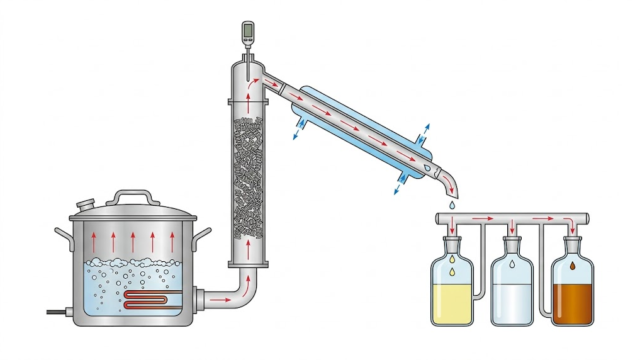 Distillation
The distillation process step by step: how distillation works and answers to common questions
The distillation process step by step: stages, fraction temperatures, heads, hearts and tails, the azeotrope and methanol - answers to common questions.
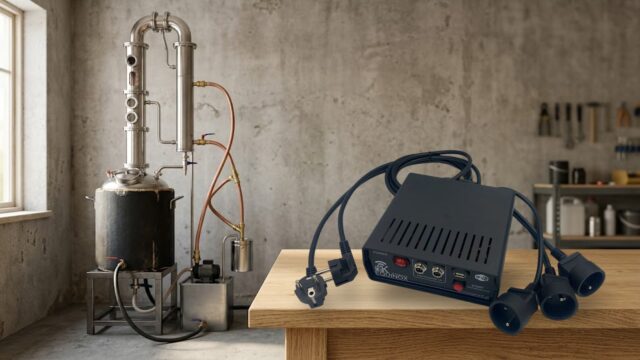 Distillation
WiFi thermometer upgrade: how to turn a thermometer into a column controller
WiFi thermometer upgrade: the add-on module turns an EQUINOX thermometer into a column controller. What stays, what is added and when the RK.10 is better.
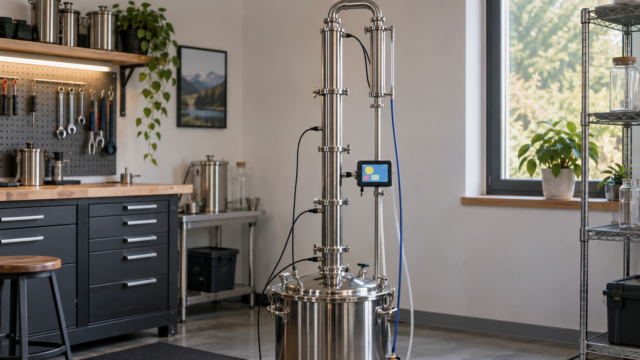 Distillation
Reflux column thermometer: how many sensors and where to fit the probes
Reflux column thermometer: four probes (boiler, buffer, plate, condenser), what each shows, alarms and a pressure sensor with boiling point correction.