
Alcohol dilution calculator - how much water to add to spirit
To dilute spirit to a chosen strength, add water in the amount: water = alcohol × (strength − target) ÷ target. For example, you dilute 1 litre of 70% spirit to 40% by adding about 750 ml of water. The calculator below does it for you - and also tells you what you get when blending two spirits and how to make vodka from ready rectified spirit.
Distillation calculator
Wash, yield, dilution, alcoholmeter correction, sugar scales, column and heating element power, costs - 16 distilling calculators in one place. Enter your data and the result updates live.
⚠️ Approximate values (for education). Results depend on raw material purity, equipment efficiency and conditions - treat them as a starting point, not a standard.
Distilling alcohol is regulated or requires a licence in many countries. Check the regulations in your country before use.
WiFi distillation thermometer - EQUINOX T-4 →Why you cannot dilute “by eye”
Once mixed, alcohol and water take up less volume than the sum of the ingredients - this is called contraction. A litre of spirit and a litre of water do not make two litres, only about 1.93 l. That is why adding water “half and half” always ends with a stronger drink than you expected.
The calculator works out the water needed from the ratio of strengths - a simple, proven formula. Because of contraction the real final volume will be 1-3% smaller than the theoretical sum, so it is always worth checking the result with an alcoholmeter after mixing and once the temperature has settled.
Three situations, one tool
1. Diluting spirit with water
You have alcohol of a known strength and want to go lower (e.g. 70% → 40%). Enter the amount of alcohol and the current and target strengths - the calculator returns the amount of water to add and the theoretical final volume.
2. Blending two spirits
Pouring two batches of different strength into one vessel? The calculator works out the resulting strength as a volume-weighted average: strength = (V₁×%₁ + V₂×%₂) ÷ (V₁ + V₂).
3. Vodka from rectified spirit
Want a specific volume of vodka at a set strength from strong spirit? Enter the target (e.g. 500 ml, 40%) and the spirit strength (e.g. 95%), and the calculator splits it into the amounts of spirit and water.
Example: 1 litre of 70% spirit → 40%
- Alcohol: 1000 ml, strength 70%, target 40%
- Water = 1000 × (70 − 40) ÷ 40 = 750 ml
- Final volume (theoretical): ~1750 ml; in reality slightly less because of contraction.
Rule of thumb: pour the spirit into the water, not the other way round - the mixture heats up less and blends better. After adding, wait and measure the strength once the temperature has settled at ~20 °C (alcoholmeters are calibrated at that temperature).
Common mistakes
- Measuring strength while warm - an alcoholmeter at a temperature other than 20 °C gives a wrong reading. Wait.
- Ignoring contraction - hence liqueurs and vodkas that come out “too strong”.
- Adding water to spirit instead of the other way round - poorer blending, more haze and a stronger heating effect.
- Trusting the label - spirit from a bottle that has been open a long time may have changed strength; measure before diluting.
Frequently asked questions
How much water per 1 litre of 95% spirit to get 40%?
About 1375 ml of water (water = 1000 × (95 − 40) ÷ 40). You get ~2.4 l of 40% vodka (in theory; in reality slightly less because of contraction).
Why did the alcohol turn cloudy after diluting?
With fruit liqueurs it is usually precipitated oils and esters. With pure spirit, haze is most often caused by:
- a high mineral content in the water used for diluting
- poor-quality distillate - too much tails / esters / oils
- contaminated distillation equipment - especially copper equipment
- poor-quality tubing in the take-off path - the most common cause
Does the order (water/alcohol) matter?
Yes - pour the alcohol into the water. The heating effect is gentler and the mixture more even.
Home production and dilution of alcohol is subject to excise law in Poland and is regulated in many other countries - this content is educational and technical.
See also: all distillation calculators · BLG calculator and wash planning - first work out how much alcohol you will get from the wash. WiFi controllers from the shop keep power and temperature stable during distillation.
More questions about diluting spirit
How do you dilute 95% to 70%?
1 litre of 95% spirit needs about 357 ml of water - an approximate value that ignores the mixture’s contraction of about 3-4%. The calculator on this page gives the exact amount with the correction. Always pour the spirit into the water, mix slowly, and before measuring with an alcoholmeter wait until the mixture has cooled to exactly 20 °C.
Is there a water-to-spirit dilution table?
The amount of water depends on the starting strength, the target strength and the measuring temperature. Approximately, per 1 litre of 95% spirit: about 267 ml → 75%; about 357 ml → 70%; about 583 ml → 60%; about 900 ml → 50%; about 1375 ml → 40%. Because alcohol and water shrink when mixed (~3-4%), the sum of the ingredient volumes is larger than the volume of the finished product - the calculator includes this correction.
How do you make 70% from 95% spirit?
Measure out the ingredients according to the calculator (about 357 ml of water per 1 litre of 95% spirit). Pour the water into the vessel first, then slowly add the spirit and stir - the mixture will warm up slightly. Before checking the strength with an alcoholmeter, wait until the liquid has cooled to 20 °C; a higher temperature gives a lower reading. Use soft or filtered water to avoid haze.
How do you dilute spirit with water?
Use soft or distilled water - hard water can make the mixture cloudy. Pour the measured water into the vessel, slowly add the spirit and stir. The reaction is exothermic, so do not seal the vessel straight away. Measure with an alcoholmeter after cooling to 20 °C. For fruit liqueurs it is worth monitoring the ageing temperature with a WiFi thermometer - an optimal 15-18 °C supports even extraction of aromas.
How do you calculate alcohol dilution?
Simplified formula: V_water = V_spirit × (C_start − C_target) / C_target, where C is % vol. Example: 1 l of 95% spirit diluted to 70% → 1000 × (95 − 70)/70 ≈ 357 ml of water. The formula ignores the mixture’s contraction (~3-4%), so the result is approximate. Exact calculations rely on Tralles alcoholometric tables; always measure strength with an alcoholmeter at 20 °C.
What goes into what - spirit into water or the other way round?
Always spirit into water - it is a safety rule. Water as the base takes the spirit more safely and ensures even mixing. The reverse order (water into spirit) causes a sudden, local exothermic reaction with a risk of splashing. The rule applies both to one-off dilution and to preparing a base for liqueurs or macerates.
Why do we pour spirit into water and not the other way round?
Mixing alcohol with water releases heat (an exothermic reaction). When water hits concentrated spirit, the local temperature jumps sharply - the liquid can splash or “kick”. Pouring spirit into water spreads the released heat through a large volume of liquid, which is safer and gives a more uniform mixture. It is the same rule as in chemistry: acid into water, not the other way round.
How do you make 70% spirit with a calculator?
The 70% spirit calculator works out how much water to add to 96% spirit to reach the target strength. Enter the volume you have and the starting strength (e.g. 96%), and the calculator gives the amount of water to add. Mix at ~20 °C - alcohol and water shrink when combined, so the final volume is smaller than the sum of the ingredients. The temperature of the mixture also affects alcoholmeter readings.
Related guides
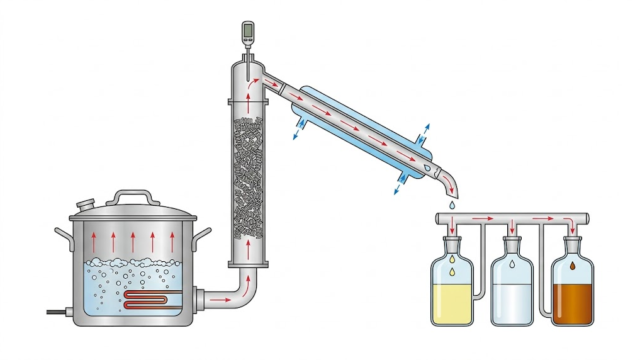 Distillation
The distillation process step by step: how distillation works and answers to common questions
The distillation process step by step: stages, fraction temperatures, heads, hearts and tails, the azeotrope and methanol - answers to common questions.
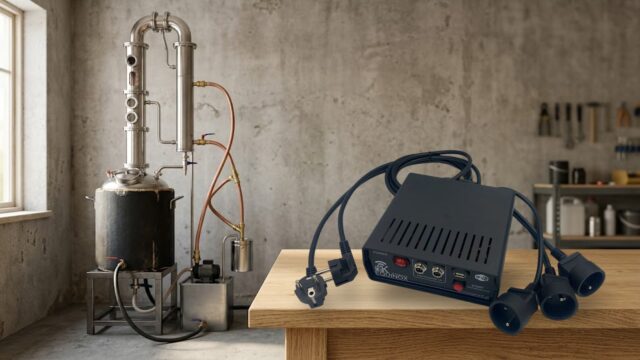 Distillation
WiFi thermometer upgrade: how to turn a thermometer into a column controller
WiFi thermometer upgrade: the add-on module turns an EQUINOX thermometer into a column controller. What stays, what is added and when the RK.10 is better.
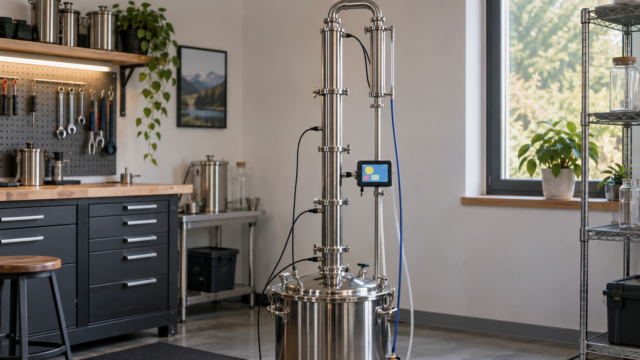 Distillation
Reflux column thermometer: how many sensors and where to fit the probes
Reflux column thermometer: four probes (boiler, buffer, plate, condenser), what each shows, alarms and a pressure sensor with boiling point correction.