
Alcoholmeter temperature correction - calculator (OIML tables)
An alcoholmeter only tells the truth at 20 °C. In warmer liquid it reads high (at 30 °C by as much as 3-4 points), in colder liquid it reads low. The calculator below converts the reading into true strength - not from a simplified “correction scale”, but from the full ethanol-water density polynomial on which the standard alcoholometric tables are built (OIML). Next to it you will also find a saccharometer correction (°Blg, practically the same as °Plato).
Distillation calculator
Wash, yield, dilution, alcoholmeter correction, sugar scales, column and heating element power, costs - 16 distilling calculators in one place. Enter your data and the result updates live.
⚠️ Approximate values (for education). Results depend on raw material purity, equipment efficiency and conditions - treat them as a starting point, not a standard.
Distilling alcohol is regulated or requires a licence in many countries. Check the regulations in your country before use.
WiFi distillation thermometer - EQUINOX T-4 →Why temperature fools an alcoholmeter
An alcoholmeter is a hydrometer - it measures the density of the liquid, and the scale converts it into % by volume assuming the liquid is at 20 °C. A warm solution expands and has a lower density, so the float sinks deeper and “sees” more alcohol than there really is. A cold one - the opposite. Ethanol expands ~5× more than water, so the error grows with strength and with every degree away from 20 °C.
Correction table (based on the OIML tables)
Values you need to add to (cold liquid) or subtract from (warm liquid) the reading:
| Reading | 10 °C | 15 °C | 25 °C | 30 °C |
|---|---|---|---|---|
| 40% | +4.0 | +2.1 | −2.1 | −4.1 |
| 50% | +3.6 | +1.9 | −1.9 | −3.8 |
| 60% | +3.4 | +1.8 | −1.8 | −3.5 |
| 70% | +3.1 | +1.7 | −1.7 | −3.3 |
| 80% | +2.8 | +1.5 | −1.5 | −3.0 |
| 90% | +2.4 | +1.3 | −1.3 | −2.6 |
| 96% | +1.9 | +1.0 | −1.1 | −2.1 |
Example: distillate straight from the cooler is at 30 °C, and the alcoholmeter shows 70%. The true strength is about 66.7% - a bigger difference than many a “margin” you add when diluting.
Saccharometer correction
The same problem affects measuring a wash: a °Blg saccharometer is also calibrated at 20 °C. A freshly made, lukewarm wash can read 0.5-1 °Blg high. The second tab of the calculator corrects the °Blg reading by the ASBC hydrometer formula - useful for wash planning.
How to measure correctly - 4 rules
- Mix and wait - the sample must be at a uniform temperature; measure it with a thermometer, not “by touch”.
- A clean cylinder, no foam - bubbles on the float can distort the reading more than temperature.
- Read at eye level, at the bottom of the meniscus.
- Ideally cool the sample to ~20 °C - then no correction is needed at all; keep the calculator for when you do not want to wait.
Frequently asked questions
The alcoholmeter showed 93% at 30 °C - how much do I really have?
About 90.9%. At high concentrations every degree above 20 °C means ~0.25 points too high.
Can I use the simplified “0.3%/°C” rule?
For a quick estimate - yes, around 40-70% it works reasonably. But the correction depends on both strength and temperature (non-linearly), which is why the calculator works from the full tables rather than a single constant.
Where do the formulas come from?
From the international density polynomial for ethanol-water mixtures (OIML R22), the basis of the standard alcoholometric tables. The calculator solves this polynomial exactly for your reading and temperature.
Measured? Now calculate the rest
Now that you know the true strength, the dilution calculator works out the water to get to 40%, and the full distillation calculator covers the wash, the column and the costs.
More questions
At what temperature should I use an alcoholmeter?
An alcoholmeter is calibrated at 20 °C - the reference temperature under OIML standards. At this temperature the reading is direct, with no conversion. The acceptable range is 15-25 °C; outside it the error grows quickly and a correction from the OIML tables is needed. Before measuring, let the sample temperature even out by waiting 10-20 minutes in stable surroundings.
At what temperature does alcohol lose strength?
Alcohol does not lose strength during storage under normal conditions - only its density changes with temperature. At higher temperatures the liquid expands and an alcoholmeter shows an apparently different concentration. A real drop in strength can happen when a liqueur or distillate is repeatedly heated uncovered - ethanol boils at 78.4 °C and gradually evaporates.
What is the correction scale for an alcoholmeter?
The correction scale depends on the alcohol concentration and the deviation from 20 °C. According to the OIML tables, a 5 °C difference can already mean a correction of 0.5-1.5% vol., and 10 °C as much as 2-3% vol.; the higher the concentration, the bigger the correction. The exact values are in the OIML R 22 tables - or in the calculator on this page, which does the conversion automatically.
At what temperature should alcohol be measured?
Alcoholmeters are calibrated at 20 °C (OIML standard) - at this temperature the reading is direct, with no correction. In practice the acceptable range is 15-25 °C, but any deviation from 20 °C needs a correction from the OIML tables (the calculator on this page helps here). The sample must be at an even temperature: stir, wait 2-3 minutes and only then lower the alcoholmeter in.
What is the density of 96% ethanol?
96% (v/v) ethanol has a density of about 0.8078 g/cm³ at the reference temperature of 20 °C (according to the OIML tables). This value changes with temperature - a rise of 1 °C lowers the density by about 0.00085 g/cm³, which translates directly into the alcoholmeter reading. That is why measuring 96% spirit without a temperature correction can give an error of several percent by volume.
How do you calculate alcohol concentration with a calculator?
The correction calculator needs two pieces of data: the alcoholmeter reading (apparent concentration) and the temperature of the liquid at the time of measurement. From these - using the OIML tables - it converts the result into the true concentration at the reference temperature of 20 °C. An alcoholmeter is calibrated at exactly 20 °C; each degree of deviation can change the reading by 0.1-0.4% vol. An accurate temperature reading (e.g. with a WiFi thermometer) translates directly into an accurate correction.
Temperature correction - why does the thermometer matter?
An alcoholmeter is a hydrometer: it measures the density of the liquid and is calibrated at 20 °C (OIML tables). Warm liquid has a lower density, so the alcoholmeter reads high. In cold liquid it reads low. Example: a reading of 70% in distillate at 30 °C is really about 66.7%. The error depends on strength and on the deviation from 20 °C, so measure the sample temperature with a thermometer, not “by touch”, and correct the result with the calculator. The same applies to a saccharometer (°Blg), which is also calibrated at 20 °C.
Related guides
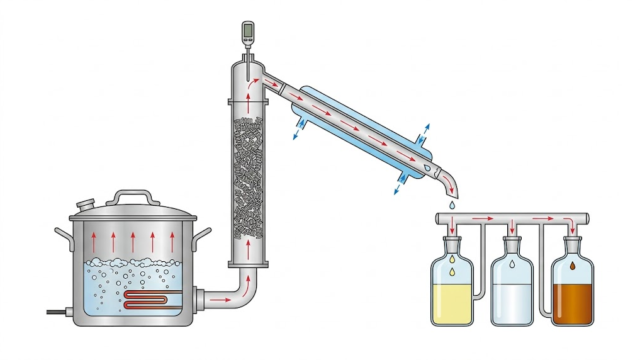 Distillation
The distillation process step by step: how distillation works and answers to common questions
The distillation process step by step: stages, fraction temperatures, heads, hearts and tails, the azeotrope and methanol - answers to common questions.
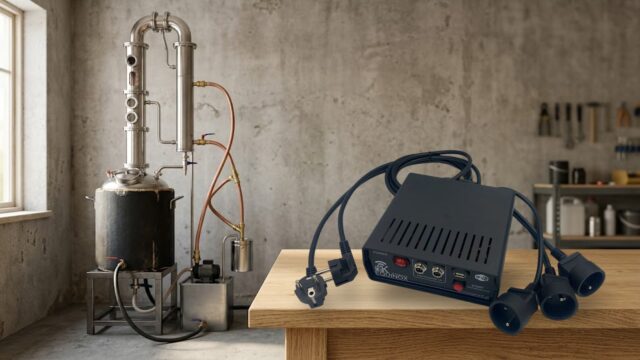 Distillation
WiFi thermometer upgrade: how to turn a thermometer into a column controller
WiFi thermometer upgrade: the add-on module turns an EQUINOX thermometer into a column controller. What stays, what is added and when the RK.10 is better.
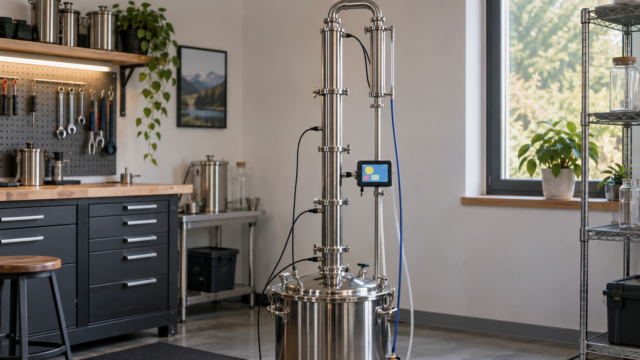 Distillation
Reflux column thermometer: how many sensors and where to fit the probes
Reflux column thermometer: four probes (boiler, buffer, plate, condenser), what each shows, alarms and a pressure sensor with boiling point correction.