
The distillation process step by step: how distillation works and answers to common questions

Contents
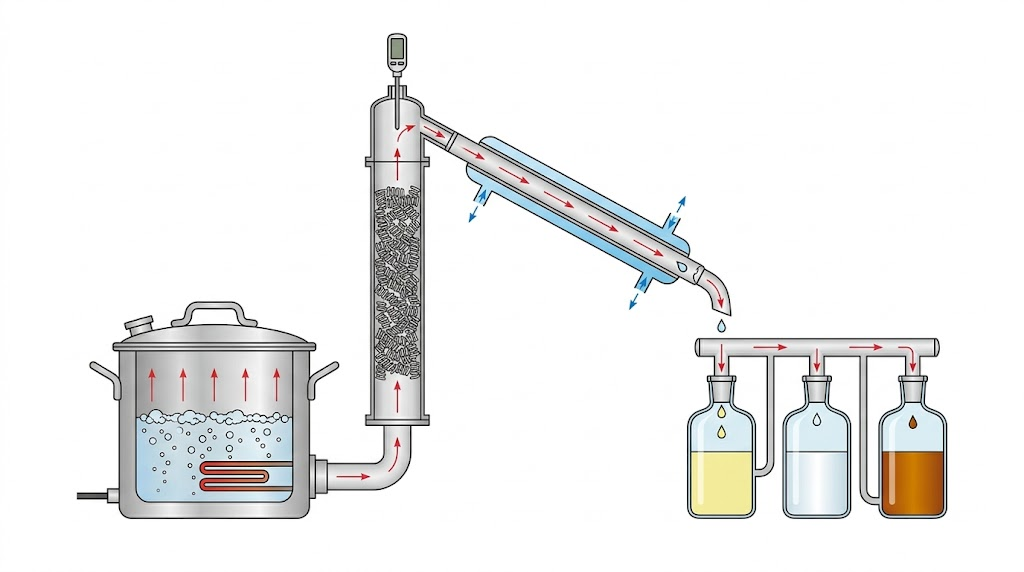
How does the distillation process work? The fermented wash is heated in the boiler until the water-ethanol mixture boils, at somewhere between 78 and 100 °C. The vapours condense in the condenser, and the distillate is collected in three fractions: heads (discarded), hearts (the main ethanol fraction, about 78.3-78.5 °C at the column head) and tails, which contain higher alcohols.
Key takeaways
- Ethanol boils at 78.3 °C at 1013 hPa. A water-ethanol mixture boils at between about 78 and 100 °C.
- The fractions come off in this order: heads → hearts → tails. The heads contain aldehydes and esters, not methanol.
- Methanol is spread across the whole run and accumulates in the tails. A thermometer will not ‘cut it out’.
- Neither distillation nor rectification at atmospheric pressure will take you past the azeotrope (about 96% ABV in practice).
- An alcoholmeter is calibrated at 20 °C. In a warmer liquid it reads too high.
How distillation works: the five stages of the process
Distillation separates the components of a liquid according to their volatility. Those that evaporate more easily pass into the vapour first; the rest stay in the boiler longer. In practice, the process can be divided into five stages.
Step 1: fermenting the wash
Before anything goes into the boiler, the yeast has to convert the sugar into alcohol. A wash of 18-22 °Blg (degrees Balling - in practice the same as °Plato, roughly SG 1.074-1.092) works best. Above about 25 °Blg the yeast struggles or dies, because the osmotic pressure is too high for it. Fermentation usually takes place at 18-25 °C, depending on the strain (more in our guide to sugar wash fermentation temperature). Each degree Blg actually fermented out gives about 0.6% ABV in the wash, so what counts is the drop in Blg, not the starting value.
Step 2: heating and boiling
The boiler is heated until the mixture boils - and it does not boil at a single fixed temperature. The more ethanol it contains, the closer it is to 78 °C; the more water, the closer to 100 °C. Pressure matters a great deal too: every 10 hPa changes the boiling point by about 0.3 °C. That is why everything ‘shifts’ downwards when the pressure is low.
Step 3: heads
The most volatile compounds come off first: acetaldehyde, acetone, ethyl acetate and other esters. They smell of solvent, and this fraction is not fit for consumption. A common rule of thumb is about 30-50 ml of heads for every kilogram of sugar in the wash, collected slowly.
Step 4: hearts
The hearts are the main ethanol fraction. A good cut shows up as a stable temperature at the column head, about 78.3-78.5 °C at a pressure of 1 atm. A steady temperature does not mean pure spirit, though, because the azeotrope sets the upper limit.
Step 5: tails
Towards the end of a simple distillation, higher alcohols (fusel alcohols) start to come through. The boiler temperature rises, and the temperature at the column head starts to creep above about 78.5 °C - the signal that the hearts are over.
Boiler
wash, heating element
Column
vapours rising
Column head
about 78.3-78.5 °C
Condenser
vapours condense
DS18B20
DS18B20
1. Heads
aldehydes, esters - discard
2. Hearts
ethanol, stable head
3. Tails
fusels, methanol in the tails
Red dots: measuring points for DS18B20 digital sensors (1-Wire, ±0.5 °C)
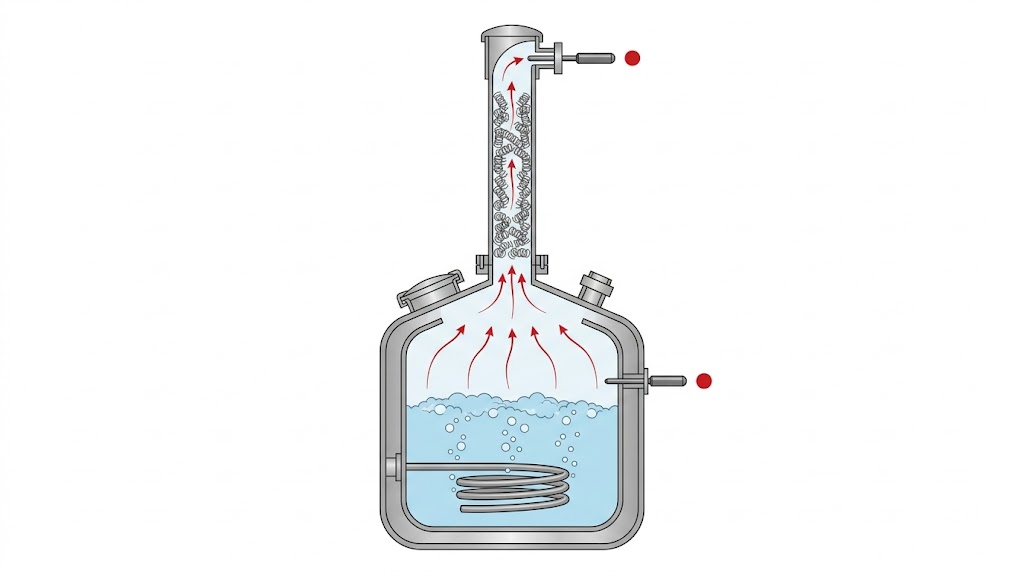
Cross-section of the boiler and column: how distillation runs, from the boiling wash to the vapours at the column head.
Temperatures in the distillation process - table
The table sets out the values worth knowing before you start reading the thermometer. Bear in mind, though, that a thermometer always shows the temperature of the whole mixture, not of any single substance.
| Substance / measuring point | Boiling point (1013 hPa) | Where in the process |
|---|---|---|
| Acetaldehyde, acetone, ethyl acetate | more volatile than ethanol | heads |
| Methanol (pure) | 64.7 °C | spread across the whole run, concentrates in the tails |
| Ethanol-water azeotrope | about 78.15 °C | concentration limit |
| Ethanol (pure) | 78.37 °C (about 78.3 °C) | hearts |
| Column head while collecting the hearts | about 78.3-78.5 °C | hearts |
| Propanol | about 97 °C | tails |
| Water | 100 °C | stays in the boiler |
| Isobutanol | about 108 °C | tails |
| Isoamyl alcohol | about 131 °C | tails |
The ethanol data come from the NIST Chemistry WebBook database.
Common questions about the distillation process
At what temperature does alcohol boil?
Pure ethanol boils at 78.3 °C at a pressure of 1013 hPa. A wash, however, is a mixture with water, so it boils at between about 78 and 100 °C, depending on its alcohol content. As the ethanol runs out, the boiler temperature gradually rises. On top of that, a pressure drop of about 33 hPa lowers the boiling point by roughly 1 °C, which is why the same still can read differently on an overcast day than in a spell of high pressure.
Does discarding the heads remove methanol?
No. Discarding the heads removes aldehydes and esters, not methanol. This is the most dangerous myth on the internet. Pure methanol does boil at 64.7 °C, but in a water-ethanol solution it does not come off first. Its volatility relative to ethanol only increases as the alcohol concentration falls, so methanol is spread across the whole run and concentrates in the tails. It therefore cannot be ‘cut out by the thermometer’, and you will never see a 64.7 °C peak. Methanol is highly toxic and can cause blindness or even death. The real protection is to avoid fermenting pectin-rich raw materials, such as poorly prepared stone fruit, and not to run the distillation into the tails.
So why are the heads discarded?
Because they contain acetaldehyde, acetone and ethyl acetate, which are irritants. So it is not just a matter of taste: the heads are simply not fit for consumption, even though discarding them does not solve the methanol problem.
How do you recognise the end of the hearts?
Two signals together mark the end of the hearts. First, the boiler temperature rises noticeably. Second, the temperature at the column head is no longer stable and starts to creep above about 78.5 °C. That is where the tails, with their fusel alcohols, begin. Measuring at two points - in the boiler and at the column head - gives a far more reliable picture than a single reading. What each measuring point shows is explained in our guide to reflux column temperature.
Why can’t you get 100% alcohol?
Because ethanol forms an azeotrope with water. This mixture, containing about 95.6% ethanol by mass (about 97% by volume), boils at about 78.15 °C, and its vapour has the same composition as the liquid. In practice, spirit from a column comes out at about 96% ABV, and more heat will not change that. Getting pure ethanol takes molecular sieves or azeotropic distillation. That is why a stable 78 °C at the column head does not mean ‘100% spirit’.
How much alcohol does 1 kg of sugar produce?
In theory, 1 kg of sucrose gives 0.538 kg of ethanol, or about 0.68 l. In practice you get 85-90% of that value, so about 0.58-0.61 l of pure alcohol. The popular ‘a litre from a kilo’ rule is physically impossible. You can do the wash, strength and dilution calculations in our distillation calculator.
How do you measure the strength of a distillate correctly?
An alcoholmeter is calibrated at 20 °C, in line with the OIML alcoholometric tables. Away from that temperature, every degree adds an error of about 0.3-0.4% ABV. A warmer liquid has a lower density, so the hydrometer sinks deeper and overstates the reading. For example, 45% read at 25 °C is really about 43% at 20 °C. A hydrometer is also only reliable in a pure water-ethanol solution: sugar, esters or tails skew the result. To convert a reading taken at another temperature, use our alcoholmeter temperature correction calculator.
How much water should you add when diluting?
More than a simple formula suggests, because it ignores volume contraction. According to the OIML tables, 1 l of 95% spirit diluted to 40% needs about 1.44 l of water, not 1.375 l. A litre of spirit and a litre of water make about 1.93 l together. You can work out the amount for your own strengths in our alcohol dilution calculator. For safety, pour the spirit into the water, not the other way round.
Are alcohol vapours dangerous?
Yes, even at room temperature. The flash point of ethanol is about 12-13 °C, and its lower explosive limit is only about 3.1-3.3% by volume in air. That is why any distillation, including of hydrosols, needs good ventilation and must be kept away from naked flames.
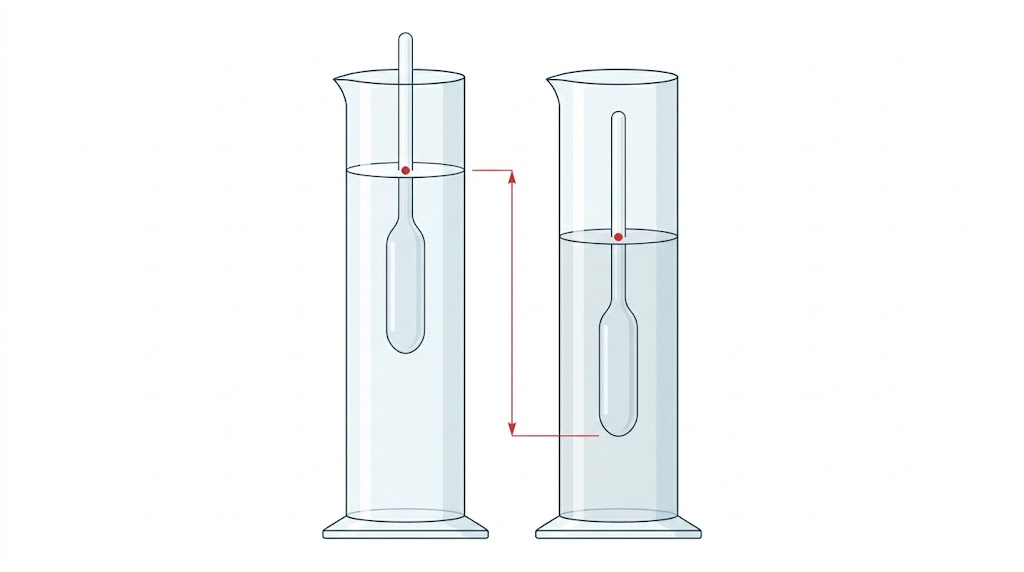
A hydrometer sinks deeper in a warmer liquid, which is why strength is measured at 20 °C in the distillation process.
How does distillation work in a reflux column?
In a reflux column - that is, in fractional distillation - the same thing happens, but many times over. The vapours rise through the column packing (for example spiral prismatic packing, SPP) while the condensate runs back down. In every section of the column, the liquid and the vapour exchange components. As a result, the most volatile fraction collects at the column head, and the cut is much sharper than in simple distillation.
Heating element power is crucial. The flooding point of a 2-inch column is of the order of kilowatts, not tens of watts. Too little power will not bring the boiler charge to the boil at all, while too much will flood the column. The hearts are taken off slowly: in rectification, below 10 ml/min for every 1 kW of power. Fusel alcohols behave in an interesting way: at low ethanol concentrations they get stuck in a zone of roughly 40-47% and build up in the middle of the column, which is why more elaborate designs have a side take-off for fusels.
Temperature in the column is measured with DS18B20 digital sensors (1-Wire bus, ±0.5 °C accuracy). They are fitted in the boiler, on the column and at the column head. If the condenser runs in INOX mode, the temperature of its jacket is measured by a separate NTC sensor.
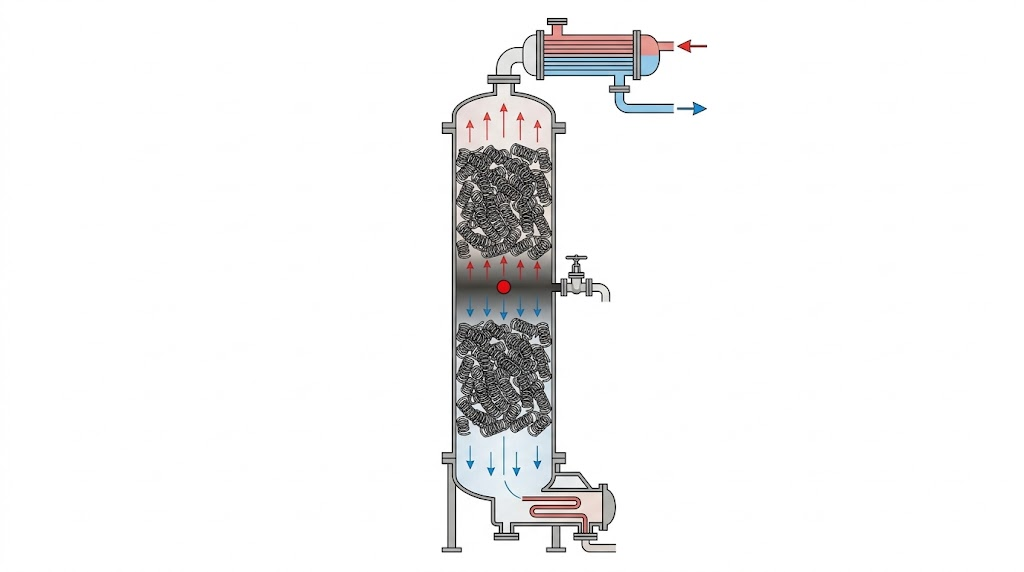
Inside a reflux column: vapour and condensate in counterflow and the zone where fusel alcohols accumulate.
Temperature monitoring from your phone: EQUINOX T-4 and EQUINOX-RK.10
Since the whole process depends on readings from the boiler and the column head, convenient measurement makes things much easier. Polish manufacturer termometrwifi offers two levels of control.
EQUINOX T-4 is a WiFi thermometer for distillation with four probes and a built-in pressure sensor, so it also shows the boiling point correction when the pressure changes. It displays temperatures in the app and sends a threshold alarm for each probe, for example when the column head goes above a set value. It is suitable for UFO, NIXON and Abratek columns. You do not have to stand by the still, yet you can see straight away when anything changes at the column head. How many probes a column needs and where to fit them is covered in our guide to the reflux column thermometer.
EQUINOX-RK.10 is a distillation column controller for reflux columns. It controls the heating elements and the solenoid valves for a reflux column from your phone, uses PID control and handles alarms. In fairness, we should point out that full distillation automation runs on a subscription model. The thermometer is for measuring; the controller is for running the process.
Bear in mind, too, that no device changes the legal position. Measuring equipment is useful wherever distillation is legal, for example for water, hydrosols or essential oils.
Summary: the distillation process in a nutshell
So how does the distillation process work? The wash boils in the boiler, the vapours condense in the condenser, and the distillate comes off in turn as heads, hearts and tails. A stable temperature at the column head indicates the hearts, but it does not mean 100% alcohol, because the azeotrope sets the limit. The heads are discarded because of the aldehydes and esters. Methanol, by contrast, is spread across the whole run and accumulates in the tails, which is why the distillation must not be run too far. Always measure strength at 20 °C. Above all, though, remember that in Poland distilling a mash without registration is a criminal offence, even for personal use. In many other countries distillation is also regulated.
More questions
What is distillation, in short?
Distillation is the separation of the components of a liquid according to their volatility. The fermented wash is heated in the boiler until it boils, at somewhere between 78 and 100 °C, and the vapours condense in the condenser. First come the components more volatile than ethanol (the heads), then the hearts with the ethanol (about 78.3-78.5 °C at the column head), and finally the tails with higher alcohols. Less volatile components, including water, stay in the boiler.
Can you distil alcohol yourself?
It depends on the regulations in your country. In Poland, private production of spirits at home is generally prohibited, and distillation is regulated in many other countries too. So check the current regulations and registration requirements before buying equipment. Distillation itself, as a physical process, is a simple separation of components by volatility, and legal uses include, for example, distilling water or essential oils. Methanol is highly toxic, so do not consume anything whose origin you are not sure of.
Want to see your column temperature on your phone?
The thermometer shows temperatures on your phone and alerts you when they cross your limit. You can extend it with heater power control or a full column controller.
See EQUINOX equipmentRelated guides
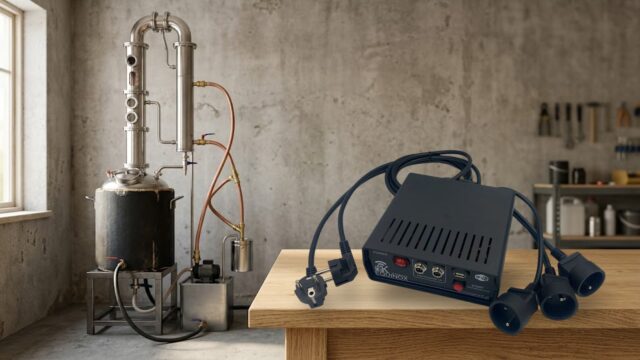 Distillation
WiFi thermometer upgrade: how to turn a thermometer into a column controller
WiFi thermometer upgrade: the add-on module turns an EQUINOX thermometer into a column controller. What stays, what is added and when the RK.10 is better.
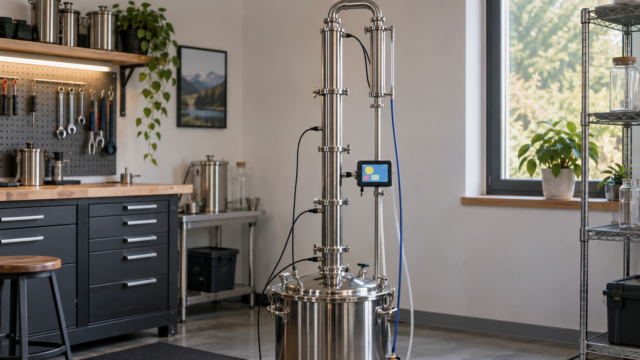 Distillation
Reflux column thermometer: how many sensors and where to fit the probes
Reflux column thermometer: four probes (boiler, buffer, plate, condenser), what each shows, alarms and a pressure sensor with boiling point correction.
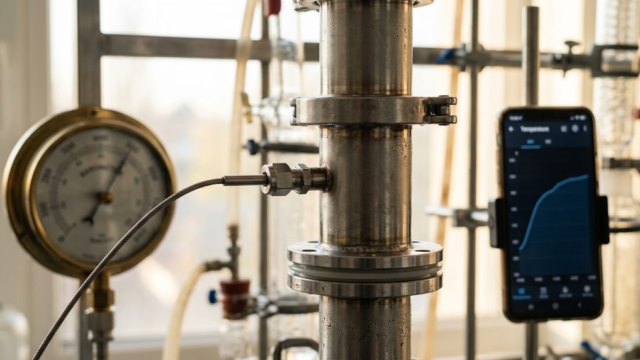 Distillation
Reflux column temperature: pressure, the reference point and what a rise means
Reflux column temperature: ethanol boils at about 78.3 °C at 1013 hPa, but the reading depends on pressure. What is the reference temperature?