
Which smoker heating element? Smoker heating element power: 2000 W or 3000 W

Contents
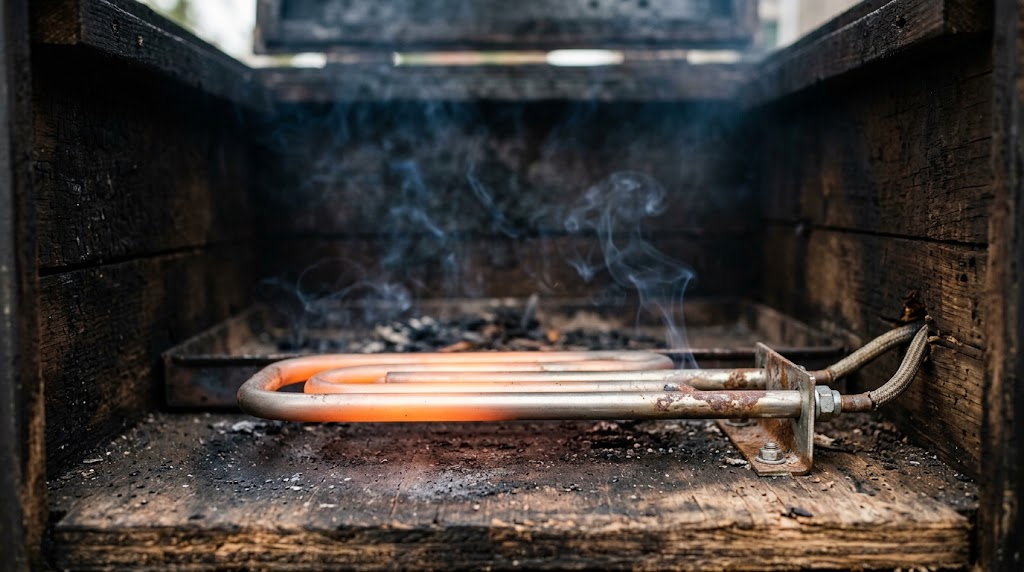
For a home electric smoker, a 2000 W heating element is usually enough. Ready-made wooden smokers of 207-514 litres use exactly that, a 2 kW heating element, including the insulated all-year versions. A 3000 W heating element is worth considering for a large, uninsulated chamber or when you smoke in winter. What matters more than the power itself is how you control it: a powerful heating element with PID control heats up quickly and then only “maintains” the temperature. A heating element that is too weak will not heat the chamber in frost, and no controller will fix that.
Smoker heating element power: what it really depends on
We match the heating element power to the chamber volume, its insulation and the weather you smoke in. The number of litres alone is not enough. The same 300-litre chamber needs much less heat in a sheltered spot in summer than in the wind in winter.
Four things affect the power requirement:
- Chamber volume. A larger chamber means more air to heat and a larger wall area through which heat escapes.
- Insulation and wall material. An insulated smoker (for example a 6.5 cm wall: board, fireplace insulation wool, board) holds heat much longer, so the heating element runs for shorter periods. Thin sheet metal gives off heat quickly.
- Weather. Frost and wind really change a smoke. In summer a 2 kW heating element heats the chamber without effort; in winter the same heating element may run almost without a break.
- Target temperature. Warm smoking at 30-50 °C needs little. Cooking in the chamber at 85 °C is a completely different requirement.
You can read more about why the temperature escapes and jumps in the article smoker temperature jumping: 5 things to check.
2000 W or 3000 W smoker heating element
A 2000 W heating element is a safe choice for most home chambers from about 200 to 500 litres. A 3000 W heating element makes sense in large, uninsulated smokers and for smoking in winter. We do not give a rigid “watts per litre” formula here, because such a formula ignores insulation and weather, and those are most often the deciding factors.
As a rough guide, for hobby smokers:
| Chamber | Typical heating element power | Notes |
|---|---|---|
| Small, up to approx. 150 l | 1000-2000 W | A metal chamber heats up quickly; control matters more than power |
| Medium, approx. 200-500 l | 2000 W | This is what ready-made wooden smokers of 207-514 l use, including insulated ones |
| Large or uninsulated, smoking in winter | 2000-3000 W | Power reserve for frost and wind; the controller handles up to 3000 W |
A rule worth remembering: it is better to have a heating element with some reserve and control how it runs than to have one that is too weak and cannot heat the chamber. A PID controller does not run a powerful heating element at full power non-stop. It switches it on in pulses, only when the chamber needs heat. A heating element that is too weak, on the other hand, means the cooking stage at 85 °C drags on for hours or never reaches the target at all, and the controller raises the NOT HEATING alarm.
Electrical protection for a smoker heating element
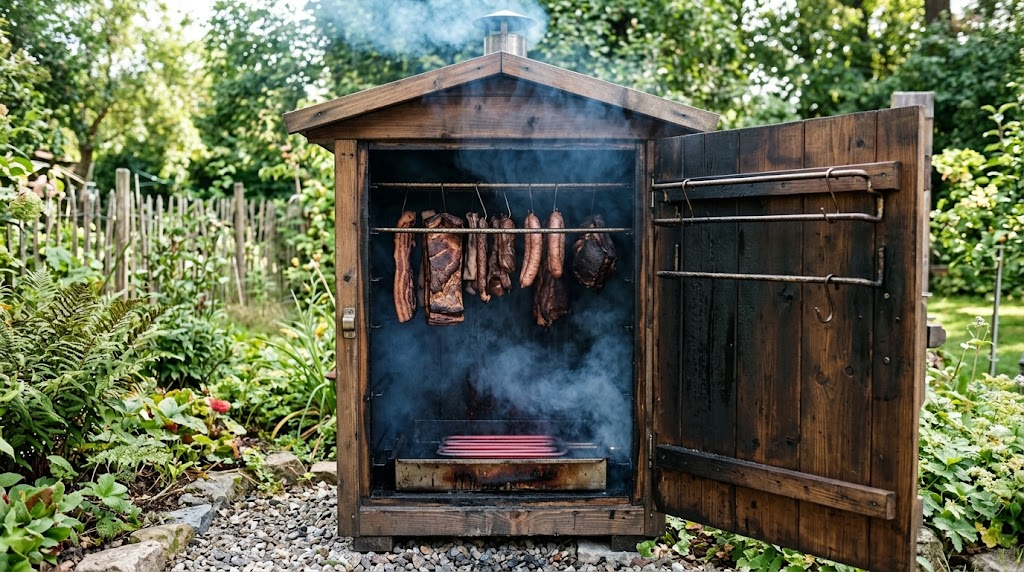
A 2000-3000 W heating element draws about 9-13 A from a 230 V socket, so the circuit must be prepared and protected for it. The SMART BARREL smoker controller runs at 230 V and handles a heating element of up to 3000 W (15 A). The auxiliary outputs, i.e. the smoke generator, fans and light, are 230 V and a maximum of 240 W each.
What to check before your first smoke:
- Fuses and a residual current device. The supply circuit must have suitable fuses and a residual current device (RCD). This is a requirement from the controller manual, not an extra. How such a device works is explained in the Wikipedia article on the residual-current device.
- Easy access to the connection. You must be able to disconnect the smoker from the mains quickly at any time.
- Tightened connections. After the first few cycles, check the connections that work under heavy load. The heating element wires sometimes need tightening.
- The electronic control circuit does not physically disconnect the heating element. If it fails, full voltage may reach the heating element. That is why we do not leave the smoker plugged in unattended.
- A 230 V heating element. The controller supplies the heating element at up to 230 V. Three-phase heating elements or ones above 3000 W are not suitable for this controller.
If you are not sure about your installation, ask an electrician. It is a one-off cost, and the smoker runs for many hours under full load.
Controlling heating element power: why PID and SSR make a difference
The heating element itself does not hold the temperature. The controller does, and the control method decides whether the chamber temperature swings or stays put. A simple thermostat switches the heating element on when the temperature drops below the threshold and off when it goes above it. With a 3000 W heating element this causes considerable swings, because the heating element has inertia: it keeps heating for a while after it is switched off.
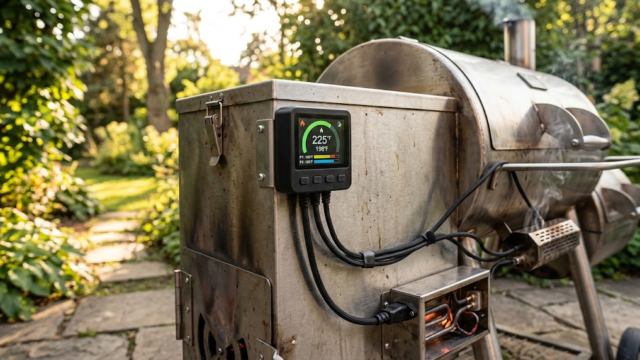
PID control works differently. The controller supplies power in portions, smaller the closer the chamber is to the target. Instead of waves you get a flat line. In the SMART BARREL smoker controller the heating element is switched by a solid-state relay (SSR) with built-in cooling, and PID auto-tuning selects the settings for your chamber on its own. Every smoker has a different heating element power, insulation and size, so the factory settings are “average”; tuning matches them to your specific equipment. If you prefer simpler operation, you can switch the controller to THERMOSTAT mode with hysteresis from 0.5 to 10 °C.
That is exactly why a powerful heating element with PID is better than a weak one without control: it reaches the target quickly and then runs in short pulses. You will find more about the differences between a simple regulator and a controller in the guide how to choose a smoker controller for an electric smoker.
Already have a 230 V heating element of up to 3000 W? All you need is the SMART BARREL smoker controller for 690 zł (≈ 157 €), which handles the heating element, smoke generator, two fans and light.
Where to place the temperature sensor relative to the heating element
Place the chamber (smoke) sensor where the smoke flows freely, away from the heating element and not touching the walls or fittings. The controller uses it to control the heating element. A sensor mounted right above the heating element will show too high a temperature, the controller will switch off the heating too early, and the food at the top of the chamber will not reach the target. You insert the meat probe into the thickest part of the food, so that the cooking stage ends exactly when the core reaches the set temperature. We have described the basics of running the process in the guide how to use an electric smoker.
Frequently asked questions
Is a 3000 W heating element too powerful for a small smoker?
No, if it is controlled by a PID controller. The controller supplies only as much power as the chamber needs, and a more powerful heating element makes up for losses faster after the door is opened. With a simple on/off thermostat, however, high power in a small chamber gives larger temperature swings.
Which heating element for a smoker in winter?
For smoking in winter, choose a heating element with a power reserve, usually 2000-3000 W, and look after the chamber insulation. An insulated smoker with a 2 kW heating element often copes better than an uninsulated one with 3 kW. Frost and wind are the most common reason the temperature does not reach the target.
Will the SMART BARREL smoker controller handle my heating element?
Yes, if the heating element is 230 V and has a power of up to 3000 W (15 A). Check these two figures on the rating plate of the heating element or smoker. You connect the smoke generator and fans to the 230 V auxiliary outputs of up to 240 W each.
Do I need two heating elements?
In a home smoker of up to 500 litres, one 2 kW heating element is usually enough; that is how ready-made 207-514 litre chambers work. If you fit two heating elements, their combined power on one controller output must not exceed 3000 W.
Summary
For a typical home smoker choose a 2000 W heating element, and for a large or uninsulated chamber and smoking in winter 3000 W. Make sure you have fuses, a residual current device and tightened connections. Control does the rest: PID control with auto-tuning means even a powerful heating element holds the temperature evenly, without waves. The SMART BARREL smoker controller from a Polish manufacturer handles a heating element of up to 3000 W, a smoke generator, fans and light, and you can run the smoke from the screen or from your phone. Check out the SMART BARREL smoker controller (690 zł (≈ 157 €)).
Want your smoker to look after itself?
The smoker controller runs drying, smoking and cooking to a program. When the meat core reaches the set temperature, you get a notification.
See the SMART BARREL smoker controllerRelated guides
 Food smoking
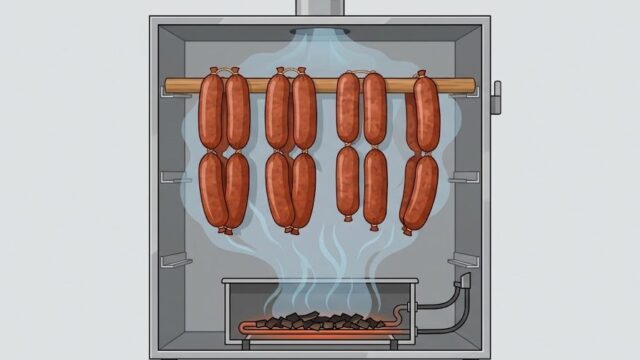
Smoking homemade sausage - from dry curing to cooking
Smoking homemade sausage step by step: dry curing, drying, choosing wood chips, a safe core temperature and the SAUSAGE program in the controller.
 Food smoking
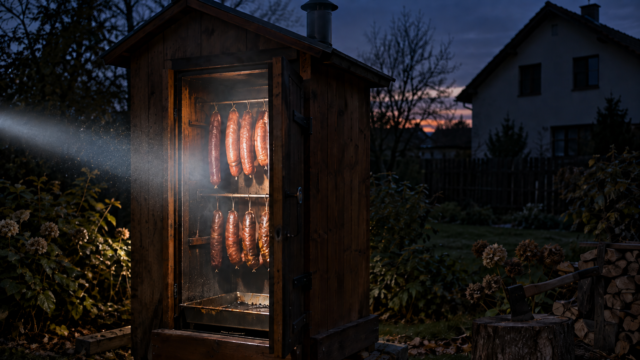
Power cut while smoking: what to do when the smoke has been interrupted
Power cut while smoking? Check how long the food spent at 5-60 °C, when to carry on smoking and how resuming the process from the cloud works.
 Food smoking
Smoker controller for Borniak, Browin, Dymbox and Dragon: what to check before connecting
A smoker controller for Borniak, Browin, Dymbox or Dragon: two rating plate figures that decide compatibility, wiring 5 outputs and the generator type.