
Curing meat - wet curing and dry curing: how to cure meat properly

Contents
How do you go about curing meat properly? Weigh out nitrite curing salt in proportion to the weight of the meat, choose wet or dry curing and keep the meat in the fridge at 2-6 °C. Turn it regularly, and once curing is finished, rinse and dry it. Ordinary salt cannot replace curing salt, because it gives neither the pink colour nor protection against botulism.
What curing meat is and why it is done
Curing means salting meat with a mixture of table salt and a small amount of sodium nitrite - that is, curing salt (nitrite curing salt). The process takes several days, so it needs a plan and a cold place. During that time the salt and nitrite penetrate deep into the fibres, while the meat proteins change their structure.
You can see and taste the results. First, the meat gains a lasting pink colour, typical of ham or streaky bacon. Second, it develops the characteristic flavour of cured meat, which you cannot get with salt alone. Third, nitrite inhibits the growth of anaerobic bacteria, including those that produce the botulinum toxin. That makes curing not just a matter of flavour but, above all, of safety.
In practice, properly cured meat has an even colour from the edge to the centre when you cut it. A grey centre with pink edges is a sign that the curing salt did not reach the middle.
How to cure meat properly, step by step
Whichever method you use, the sequence is the same. Only the way you apply the curing salt changes. So it is worth mastering the order first, and only then choosing the method.
- Prepare the meat. Weigh it, remove membranes and excess blood, and trim larger pieces to an even shape.
- Measure out the curing salt. Always calculate the dose for the weight of the meat (dry curing) or of the meat and water (wet curing).
- Apply the curing salt or pour over the brine. The meat must be covered evenly.
- Put it in the fridge at 2-6 °C, in a tightly sealed container.
- Turn it regularly, ideally every day.
- Rinse and dry the meat once curing is finished.
Getting the curing salt dose right matters, because too small a dose will not protect the meat, while too large a dose gives a product that is salty and dangerous. Instead of copying out tables, use our curing salt calculator, which works out the curing salt per kilogram of meat and per litre of water.
Wet curing - the brine, step by step
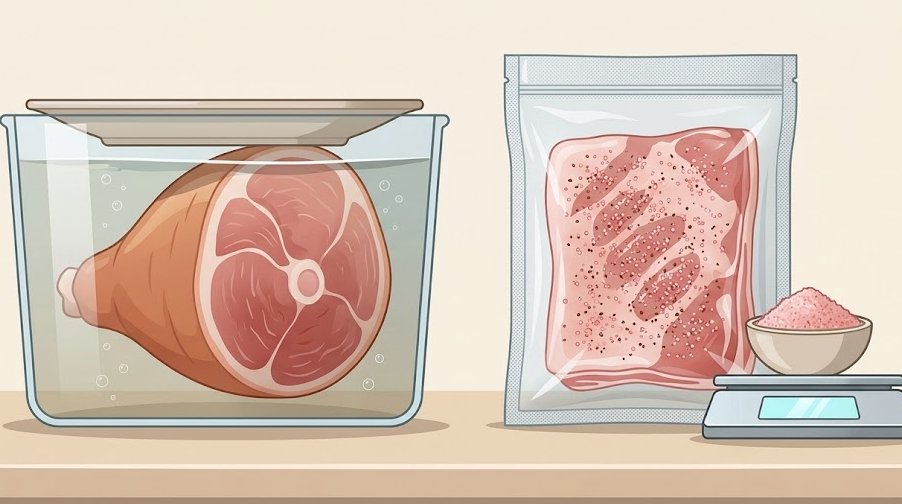
Wet curing means submerging the meat in a solution of curing salt in water. This method works well for large pieces such as ham, pork neck (collar) or pork loin. The brine surrounds the meat on every side, so the curing salt penetrates evenly and the risk of under-salted spots is lower.
Making the curing brine
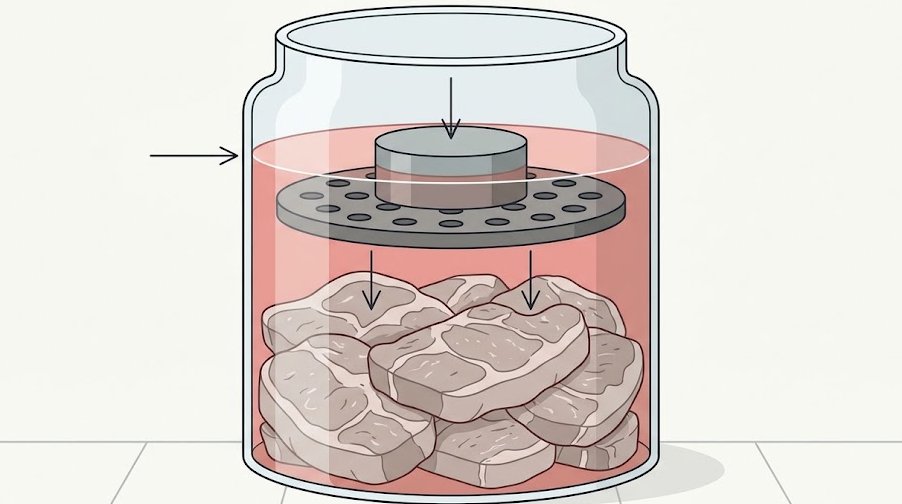
Bring the water to the boil and let it cool completely, and only then dissolve the measured curing salt and any spices in it. Warm brine is a mistake, because it warms the meat and encourages bacteria. Pack the meat tightly in a container made of glass, stoneware, stainless steel or food-grade plastic. Then pour the brine over so that the meat is fully covered, and weigh it down with a plate. A piece sticking out above the brine will not cure properly.
Turning the meat in the brine
Once a day, rearrange the pieces so that the bottom ones end up on top. This evens out the concentration around the meat. At the same time, check the smell and look of the brine. Brine that is slimy, cloudy or smells sour means something has gone wrong - do not try to save that batch.
For very thick pieces, injecting is also used, meaning some of the brine is introduced deep into the meat with a syringe. This shortens the curing salt’s path to the centre, but it requires clean tools and accurate dosing.
Dry curing - when it works best
Dry curing means rubbing or mixing the meat with curing salt without adding water. Over time, the juices drawn out of the meat form a small brine of their own. The method gives firmer, more aromatic meat, which is why it is popular for pork belly (streaky bacon), pork tenderloin and raw cured meats.
For sausage, use dry curing only. Cut the meat into roughly 2×2 cm cubes, mix it thoroughly with the measured curing salt and put it in the fridge. You do not cure formed sausages in brine, nor rub curing salt into filled casings. The later stages are described in our guide to smoking sausage - time, temperature and a step-by-step guide.
With dry-cured pieces, turning is just as important. It is best to keep the meat in a sealed bag or container and turn it every day, massaging it lightly. As a result, the juices drawn out spread the curing salt over the whole surface.
Wet curing or dry curing - a comparison
Both methods are correct, but each suits different products. There is also a combined method: the meat is first rubbed with curing salt and then covered with brine. It combines a quick start at the surface with even penetration deep inside.
| Feature | Wet curing | Dry curing | Combined |
|---|---|---|---|
| Best for | ham, pork loin, pork neck | pork belly, sausage (cubed), pork tenderloin | large, irregular pieces |
| Evenness | high | depends on turning | high |
| Texture | juicy | firm, drier | in between |
| Space in the fridge | large container | bag or container | large container |
How many days to cure meat
Curing time depends above all on the thickness of the piece, the method and the temperature. Thick pieces need more days, while meat cut into cubes cures fastest. So it is not a good idea to carry the time over from one recipe to a different product. Stick to the time given in a proven recipe, and work out the curing salt dose in the calculator.
Temperature is crucial here. Cure in the fridge at 2-6 °C. Above that, the risk of bacterial growth rises; below it, the process slows down noticeably. Also check the meat every day, so that you spot any change in smell or too little brine straight away.
Rinsing and drying after curing
After curing, take the meat out and rinse it thoroughly in cold water. This washes the excess salt off the surface. Then pat it dry with kitchen paper and hang it up. A wet surface takes smoke poorly, and the result is an uneven product with streaks.
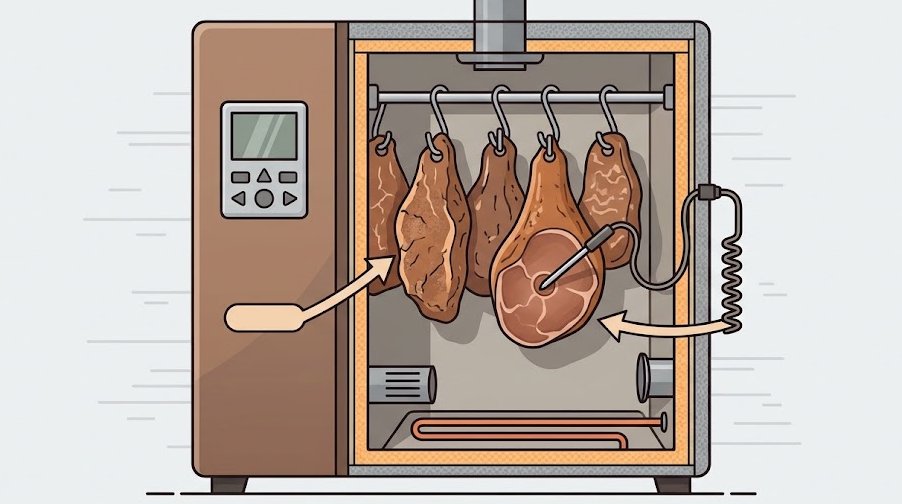
On a dry surface a thin, slightly tacky layer forms (the pellicle), to which the smoke sticks evenly. In a smoker with the SMART BARREL controller, this stage is run by the automatic program: after dripping and preheating comes “DRYING”. The “HAM” program dries at 45 °C. The controller menu can be switched between Polish, English and Czech in the app; Polish is the default. The chamber temperature is measured by a digital DS18B20 sensor, and the core temperature by an NTC probe pushed into the product. We show how to carry on with the smoking using ham as an example in our guide to smoking ham - time and temperature.
The most common curing mistakes
Most failed smoked meats go wrong at the curing stage, not in the smoker. These are the mistakes we see most often:
- Dosing by eye. Weigh the curing salt on scales, because a spoon does not tell you the actual weight.
- Too warm. Curing in a cellar or on a balcony with no temperature control is asking for trouble.
- No turning. The result is grey patches and an under-cured centre.
- Meat above the brine. The part sticking out gets no curing salt.
- Skipping the rinse. The product ends up over-salted on the outside.
- Mixing methods for sausage. Sausage meat is cured dry only, in cubes.
Nitrite safety and botulism
The nitrite in curing salt is effective precisely because it is powerful. Its job is to inhibit Clostridium botulinum bacteria, which in the oxygen-free conditions inside cured meat can produce the botulinum toxin. This toxin is life-threatening, which is why curing is not something to cut corners on.
At the same time, nitrite in excess is harmful. So use only ready-made food-grade curing salt, never pure sodium nitrite. Store it in a labelled container, away from ordinary salt and out of reach of children. The EU’s Commission Regulation (EU) 2023/2108 lowered the maximum amount of nitrites that may be added to meat products. Since 9 October 2025 this has, as a rule, been 80 mg/kg (expressed as nitrite ion). The regulation applies to producers, but it shows the direction clearly: the more precisely you dose, the better.
Curing does not replace heat treatment either. Cured meat must be brought up to a safe core temperature, which we have collected for individual products in our meat done temperature chart.
Curing with ordinary salt - why not
Ordinary table salt only partly preserves meat. It contains no nitrite, so after heat treatment the meat turns grey like a roast, not pink like ham. It also lacks the typical cured flavour. Above all, though, salt alone gives no protection against botulism in smoked and cooked products. So treat meat salted with ordinary salt as a roast, not as a traditional cured meat.
Frequently asked questions about curing meat
How do you cure meat properly at home without special equipment?
All you need is kitchen scales, a container made of glass, stoneware or stainless steel, and a fridge that holds 2-6 °C. What matters most is an accurate dose of curing salt and turning the meat every day.
Can curing brine be reused?
No. After curing, the brine contains meat juices and microorganisms from the meat, so you pour it away when the process is finished. Make fresh brine for the next batch.
Does cured meat need soaking before smoking?
A thorough rinse in cold water is usually enough. A short soak helps when the surface is clearly over-salted, but with the correct dose of curing salt it is rarely needed.
How can you tell the meat is properly cured?
The cross-section has an even pink colour right to the centre, and the smell is fresh and slightly salty. A grey centre means the curing was too short or the dose too small.
Summary
How do you cure meat properly? Weigh the curing salt accurately, match the method to the product, keep the meat at 2-6 °C and turn it every day. Then rinse it, dry it and only then move it to the smoker. Well-cured meat is half the battle. The other half is a stable smoking and cooking temperature, which in an electric smoker is handled by the SMART BARREL controller until the NTC probe shows the target core temperature.
Want your smoker to look after itself?
The smoker controller runs drying, smoking and cooking to a program. When the meat core reaches the set temperature, you get a notification.
See the SMART BARREL smoker controllerRelated guides
 Food smoking
Wood or metal smoker? Which electric garden smoker will last for years
Wood or metal smoker? We compare insulation, condensation, durability and 150-500 L capacity of electric smokers, plus the role of the smoker controller.
 Food smoking
REX C100 or ready-made? A DIY smoker temperature controller compared honestly
DIY smoker temperature controller with a REX C100 or STC 1000, or a ready-made one? Parts, time, common faults and when DIY is really enough.
 Food smoking
Electric smoker PID auto-tuning: what tuning does and why the temperature swings
Electric smoker PID auto-tuning: what tuning does, the conditions (smoke sensor, chamber above 30 °C), how long it takes and when to repeat it.