
Wood or metal smoker? Which electric garden smoker will last for years

Contents
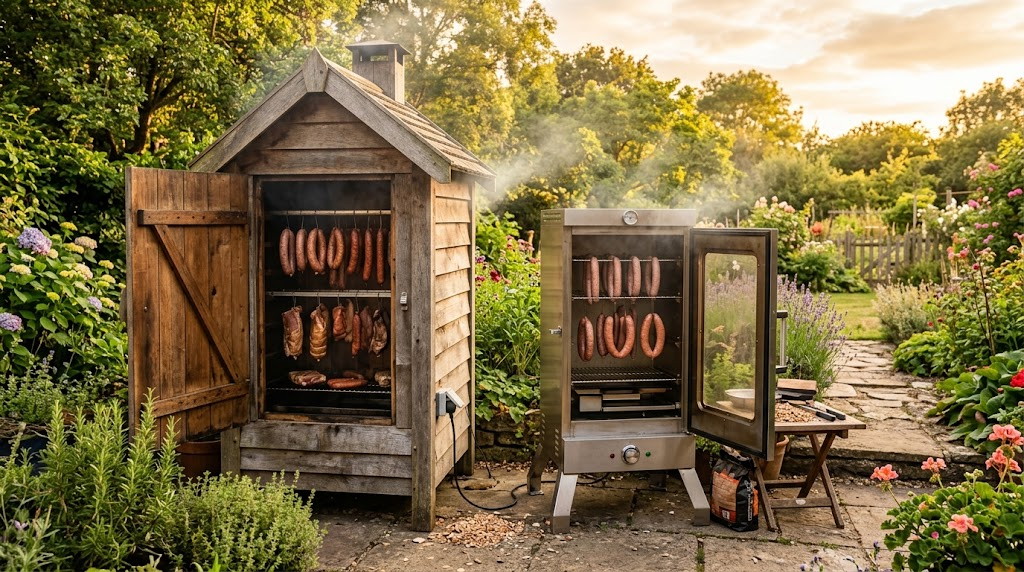
When you are choosing a wood or metal smoker, remember this: a wooden electric smoker holds the temperature better and looks traditional, while a metal one is easier to clean and less sensitive to the weather, but it loses heat faster and collects condensation on its walls more often. For smoking all year round, an insulated chamber works best, whatever the material. The differences between the materials are largely evened out by a smoker controller with PID control, which matches the heating element’s output to the specific chamber. When choosing a garden smoker, look at the insulation, capacity and ease of cleaning, not just the material itself.
Wood or metal smoker: insulation and temperature stability
Wood is a natural insulator; sheet metal is not. That is the most important difference in everyday smoking. A wooden chamber heats up more slowly, but it also cools down more slowly, so after you open the door it gets back to the set temperature faster and the heating element runs for less time. Thin sheet metal heats up in an instant and loses heat just as quickly, especially in the wind.
In practice this means that an uninsulated metal smoker in freezing weather needs more power from the heating element and runs almost non-stop, and the temperature reacts to every gust. An uninsulated wooden one copes better, but in a hard frost you will feel the difference too.
The solution for winter smoking is an insulated wall. In our ready-made wooden smokers with our controller, the 237 and 413 litre versions have a three-layer wall: 2 cm board, 3 cm fireplace insulation wool and 1.5 cm board, 6.5 cm in total on the sides and back. Such a chamber loses heat more slowly, the temperature is more stable and the 2 kW heating element runs for less time. The uninsulated 207 and 514 litre versions work well in season and in milder weather. The same principle applies to metal chambers: an insulated stainless steel chamber will behave much like a wooden one.
Condensation and moisture in the chamber
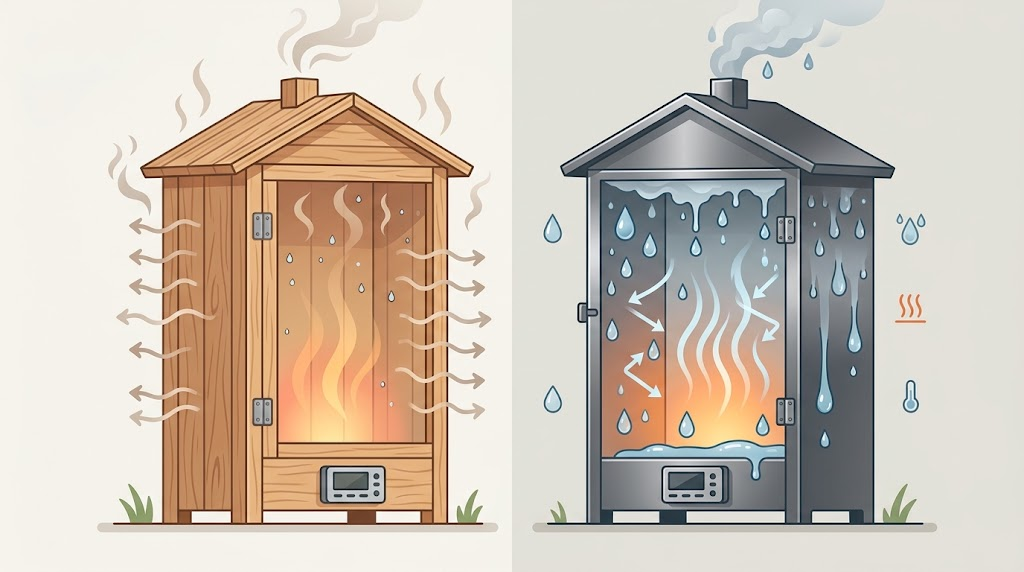
A metal wall is colder than the smoke, so steam from the food condenses on it and drips. Wood has a higher surface temperature and partly absorbs moisture, so there is less condensation. The physics behind this is explained in Wikipedia: dew point: when moist air touches a surface colder than the dew point, water condenses on it.
Why does it matter? Moisture is the biggest enemy of smoking. A wet surface catches smoke like soot, and the meat comes out bitter and sour, with a grey skin. Drops falling from the ceiling of a metal chamber onto sausages leave spots. That is why the drying stage, i.e. evaporating moisture from the surface without smoke, is even more important in a metal smoker than in a wooden one. The fan helps too: the controller adjusts it smoothly from 0 to 100%, and during drying it can run harder to blow the moisture out, and more gently during smoking. We show what hot and cold smoking look like in practice, using an example, in the article smoking bacon hot and cold.
Durability and cleaning: wood vs stainless steel
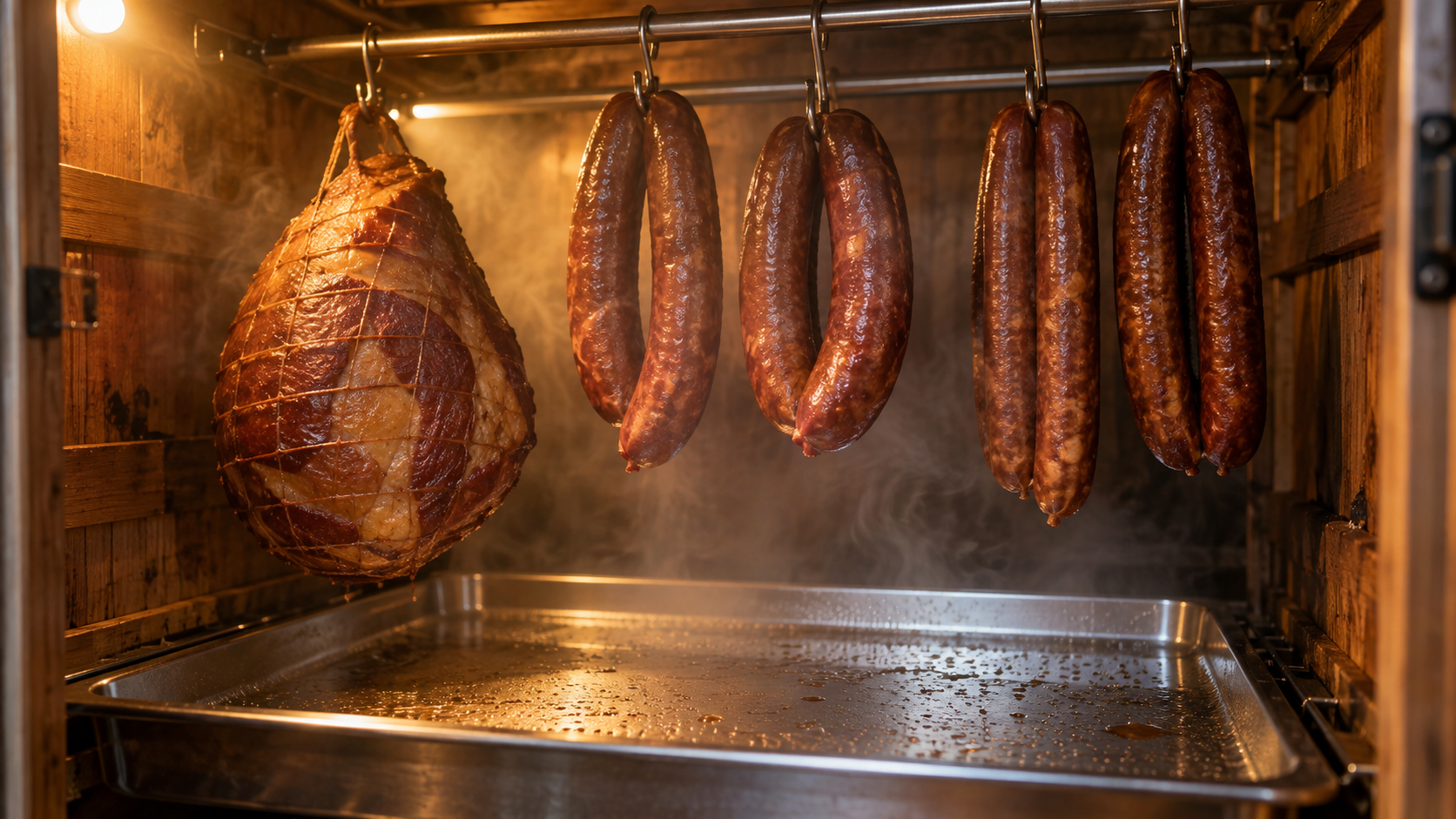
A stainless steel smoker does not rot or crack, and you can wipe it down with a damp cloth. That is its strongest argument. Wood needs good workmanship, but a well-made wooden smoker lasts for years and gains character with every smoke.
What to look for in a wooden smoker:
- Seasoned wood. At high temperatures it does not give off unpleasant smells that could pass into the product.
- Charred surface. It stands up well to rain and sun in the garden.
- Stainless steel sheet on the floor. It protects the wood from the heat of the heating element and from dripping fat, and cleaning comes down to wiping the sheet.
- Stainless steel drip tray and hooks. They catch the fat; the wooden walls only collect smoke.
- A roof fitted to the chamber, solid hinges and a latch. A tight door means less heat loss and more even smoke.
A metal smoker needs less attention when you buy it, but check it too: the thickness of the sheet, the quality of the welds and whether the chamber has any insulation at all. Thin, uninsulated sheet metal is the hardest case for temperature stability.
Garden smoker capacity: 150-500 litres
For a family, a chamber of about 200 litres is enough; for bigger batches and smoking for friends, choose 400-500 litres. Capacity determines how many sausages and hams you can fit in one batch, but also how much heat the heating element has to deliver.
As a rough guide, taking our ready-made wooden electric smokers with a WiFi controller as an example:
| Capacity | Who it suits | Insulation |
|---|---|---|
| 207 L | a family, weekend smoking in season | no |
| 237 L | limited space, smoking all year round | yes, 6.5 cm |
| 413 L | large batches, smoking all year round | yes, 6.5 cm |
| 514 L | the biggest batches, festive occasions, in season | no |
Do not oversize “just in case”. Packing the chamber too tightly gives pale patches where the smoke cannot reach, but a large empty chamber means heating air for nothing. Also remember the spacing of the sticks and hooks: the pieces must not touch.
How a controller evens out the differences between chambers
A smoker controller with PID control and auto-tuning matches the heating element’s output to the specific chamber, so the difference between wood and metal stops being decisive. The SMART BARREL smoker controller comes with “average” factory settings for a typical hobby smoker. If the temperature in your chamber fluctuates or overshoots the set value, you start tuning: the controller cyclically switches the heating element on and off, measures how the chamber responds and selects the settings itself. In a metal chamber, which responds quickly, it will get different parameters than in an insulated wooden one, which responds slowly.
On top of that there are two independent, smoothly controlled fans (important in a metal chamber during drying), a chamber sensor placed in the smoke flow, away from the walls, and the TEMP DROP alarm, which will flag a door that is not fully closed or a heating element that is too weak for the frost. The controller menu can be switched between Polish, English and Czech in the app; Polish is the default. With your consent, the app adds the weather to every session, so in the history you will see how frost and wind affected the process in your chamber. You can read more about the causes of temperature jumps in the article electric smoker temperature control problems? Check these 5 things, and about choosing a controller in the guide how to choose a smoker controller for an electric smoker.
Already have a chamber, wooden or metal? The SMART BARREL smoker controller (690 zł (≈ €157)) fits any electric smoker with a 230 V heating element of up to 3000 W.
Frequently asked questions
Is a wooden smoker suitable for winter?
An uninsulated wooden smoker will cope in mild weather, but for freezing, windy conditions choose an insulated version. A 6.5 cm wall with fireplace insulation wool holds the temperature with less work from the heating element, so such a chamber works all year round.
Do products come out worse in a metal smoker?
No, as long as you make sure the food is properly dried and the temperature is stable. Metal collects condensation more often, which is why drying without smoke and good use of the fan matter more. A PID controller with auto-tuning will even out the fast response of thin sheet metal.
What garden smoker capacity is right for a family?
About 200 litres is enough for weekend smoking of sausages, ham and fish for a family. If you smoke for friends or for festive occasions, consider 400-500 litres. Remember that a larger chamber means more work for the heating element and a longer warm-up.
Does a smoker controller fit both types of chamber?
Yes. You can fit the SMART BARREL controller to any electric smoker, wooden or metal, factory-made or home-built. The condition is a 230 V heating element of up to 3000 W, and a smoke generator and fans of up to 240 W. PID auto-tuning will select the settings for the material and size of the chamber.
Summary
A wooden electric smoker wins on insulation, less condensation and a traditional look; a metal one wins on durability and easy cleaning. For smoking all year round, what matters most is an insulated wall, and for an even colour, thorough drying before the smoke. The controller evens out the rest: PID control, fans and alarms make both chambers hold the temperature just as evenly. If you are looking for a ready-made solution, we have a wooden electric smoker, 207-514 litres with a factory-fitted controller, and if you already have a chamber, all you need is the SMART BARREL smoker controller for 690 zł (≈ €157) from a Polish manufacturer.
More questions
Can a smoker be made of pine?
Yes, the chamber walls can be made of pine, as long as the wood is well seasoned, without resinous knots or resin streaks. Fresh pine gives off a resin smell during hot smoking (chamber about 50-85 °C), which passes into the product. Do not varnish or treat the inside, and cover the floor with stainless steel sheet. Fuel is a different matter: never use pine or any other softwood chips, because the resin makes the product bitter. Choose alder, beech or fruitwood.
Which electric smoker do you recommend?
For smoking all year round, choose a smoker with an insulated chamber, and match the capacity to your batch size. For a family, about 200 litres is enough; for bigger batches, 400-500 litres. In our wooden smokers the 237 and 413 litre versions are insulated (6.5 cm wall), while the 207 and 514 litre versions work well in season. Also look for a tight door, a drip tray and stainless steel hooks.
Is it worth buying an electric smoker?
Yes, if you smoke regularly and want repeatable results. An electric smoker with a PID controller holds the set temperature and lets you dry the food properly before the smoke, and the end result depends on that. With an insulated chamber you depend less on the weather. Before you buy, check the insulation, capacity and ease of cleaning, not just the material of the chamber.
Is a wooden smoker any good?
Yes, a wooden smoker is a good choice, because wood insulates naturally. The chamber heats up more slowly but also cools down more slowly, so after you open the door it gets back to the set temperature faster and the heating element runs for less time. It also collects less condensation than sheet metal. Look for seasoned wood, a stainless steel sheet on the floor, a tight door and, for winter, an insulated wall.
Want your smoker to look after itself?
The smoker controller runs drying, smoking and cooking to a program. When the meat core reaches the set temperature, you get a notification.
See the SMART BARREL smoker controllerRelated guides
 Food smoking
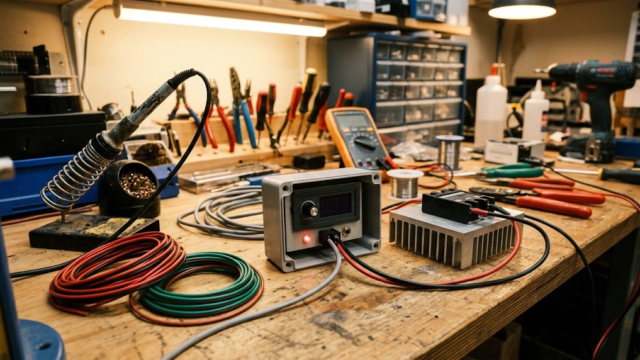
REX C100 or ready-made? A DIY smoker temperature controller compared honestly
DIY smoker temperature controller with a REX C100 or STC 1000, or a ready-made one? Parts, time, common faults and when DIY is really enough.
 Food smoking
Electric smoker PID auto-tuning: what tuning does and why the temperature swings
Electric smoker PID auto-tuning: what tuning does, the conditions (smoke sensor, chamber above 30 °C), how long it takes and when to repeat it.
 Food smoking
Curing meat - wet curing and dry curing: how to cure meat properly
Curing meat properly: wet curing vs dry curing, brine, turning, a fridge at 2-6 °C, rinsing, common mistakes and nitrite safety.