
Drying before smoking - why does smoked meat come out bitter and pale?

Contents
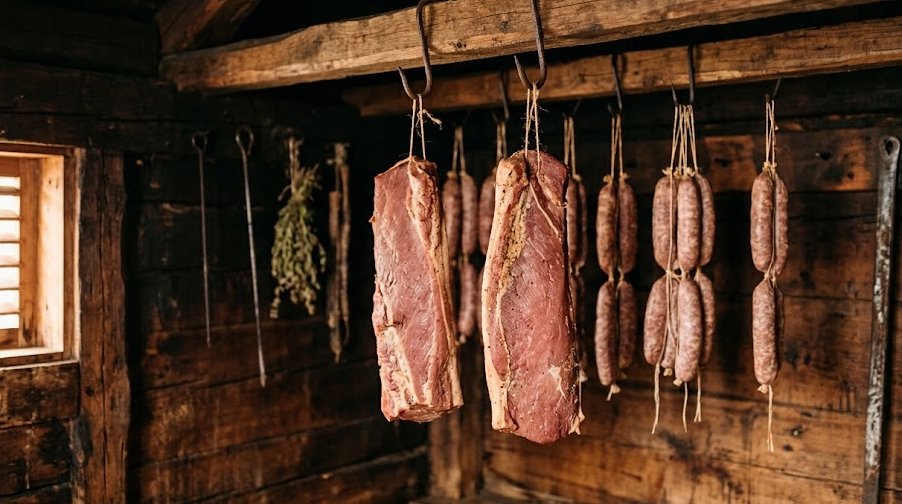
Drying before smoking is the most important preparation stage in the whole process. A wet meat surface does not take on smoke evenly - smoke compounds settle on the moisture like soot and give a bitter, sour taste and grey, dull skin. A dry, slightly tacky film called the pellicle lets the smoke bind evenly, so the product takes on a beautiful, glossy colour.
Key takeaways
- A wet surface is the most common cause of the bitter taste and grey colour of homemade smoked meats.
- The pellicle - a dry, slightly tacky film - forms during drying and decides the quality of the finished product.
- Chamber temperature for drying: approx. 40-50 °C, no smoke, vent slightly open; approximate time 45-120 minutes.
- SMART BARREL runs the drying stage automatically, with no need to watch the clock.
Why does moisture ruin smoked meat during smoking?
Moisture on the meat surface is the biggest enemy of good smoking. When the food goes into the chamber wet - straight from the brine, after rinsing or after a night in a cold cellar - water vapour mixes with the smoke and, instead of a healthy film, forms a sticky, dark deposit on the skin. Creosote and phenolic compounds, which normally give an appetising golden colour, stick to the moisture haphazardly. The result is well known to anyone who has ever skipped the drying stage: a bitter, acrid taste, grey or black-speckled skin, a sour smell and a rubbery texture when cut.
That is why drying before smoking is not an optional extra - it is the condition on which everything that happens afterwards depends. Even the best dry alder chips and a perfect chamber temperature will not save the product if the meat surface was not dry before its first contact with smoke.
In practice the difference is immediate and visible to the naked eye. A sausage hung wet straight out of the brine comes out dark grey after an hour in the smoke, with patches and dull skin. The same sausage after 60 minutes of drying at 40 °C without smoke comes out golden, glossy, with an even colour from one end to the other. There is no magic here: it is the physics and chemistry of smoke on a dry versus a wet surface.
What is the pellicle and how do you get it?
The pellicle is a dry, slightly tacky and gently shiny film that forms on the meat surface during drying. It is not the result of any chemical treatment - it is natural proteins and sugars migrating to the surface and forming a thin, permeable layer. It is exactly this layer that allows smoke compounds to adhere evenly and lastingly. Without a pellicle the smoke has nothing to hold on to: it passes by, settles irregularly or combines with residual moisture into an unappetising deposit.
You can recognise the pellicle by touch: dry and slightly sticky, not wet, not slippery. When you touch it with a finger you feel a gentle resistance, like a slightly dried glaze. That is the signal that the food is ready for smoking.
There are two ways to get it:
Cold - after curing, the meat is hung in an airy, cool place (fridge, cellar) for several hours up to a day or so. The surface dries slowly, and the film is strong and uniform. This method is particularly good for cold smoking (chamber below ~30 °C), where the process takes a long time - the pellicle must be there before the first contact with cold smoke.
In the smoker chamber - heat the chamber to approx. 40-50 °C, hang the food and dry it for 45-90 minutes without smoke, with the smoke outlet or vent slightly open. The moisture must have somewhere to escape. This is the most common method for hot and warm smoking. The time is approximate - you judge readiness by touch alone.
One rule is absolute: while drying in the chamber, we do not switch on the smoke. The pellicle must form before contact with smoke, not during it.
- DRIPPING
no smoke, no heating - DRYING
40-50 °C, no smoke, the pellicle forms - key stage - SMOKING
smoke on, colour and aroma - COOKING
core to target, 68-74 °C - POACHING
water at 75-80 °C, barely simmering - READY
How to dry correctly before smoking?
The pattern is the same for all products - only the temperature and time differ, depending on the thickness of the meat and the smoking method.
Step 1 - take the meat out of the cure and dry the surface. After taking it out of the brine, wipe the food with a paper towel. Remove excess moisture before you hang anything.
Step 2 - hang the food with gaps between pieces. Pieces touching each other block the airflow and dry unevenly. Leave at least a few centimetres between sausages and pieces.
Step 3 - set the chamber to 40-50 °C, no smoke, vent slightly open. The moisture evaporates - it must have somewhere to go. A closed chamber without ventilation steams instead of drying. 40 °C is enough for thin sausages; thicker products (ham, Kraków sausage) need up to 50 °C.
Step 4 - check by touch, not by the clock. You will recognise a finished pellicle by hand: the surface is dry and slightly sticky, not wet, not slippery. Only now do you start the smoke.
Which drying mistakes make smoked meat bitter or pale?
Each mistake leaves a different sign on the finished product - it is worth knowing them so you can tell straight away what went wrong.
No drying at all - the most common mistake. The food goes into the chamber wet. Result: a bitter, acrid taste, grey or blackish skin, a dull colour, often a sour smell. The smoke settles haphazardly on the damp surface.
Drying with smoke - the smoke is switched on too early, before the pellicle has had time to form. Result: uneven colour, light and dark patches, a rough surface. Smoke compounds react with residual moisture before the film forms.
A closed chamber without ventilation - the temperature is right, but the moisture has nowhere to escape, so the chamber steams instead of drying. Always open the smoke outlet or vent slightly during this stage.
Drying temperature too high - above approx. 60-65 °C the meat starts to denature from the outside instead of drying. The skin becomes hard and impermeable. The pellicle is too thick and hard, and blocks the smoke later.
An overloaded chamber - the pieces touch and the air does not circulate. Pale areas show on the finished product - exactly where the pieces touched each other or where the smoke did not reach during smoking.
Damp wood chips - this is a mistake of the smoking stage, but worth mentioning here: wet chips produce steam instead of smoke and generate thick grey smoke full of creosote. With smoke like that, even a perfect pellicle will not save the product. Always use dry chips - alder gives a mild, golden colour; beech a clean, distinctive, darker shade; oak a strong, mahogany one; apple and cherry mild, slightly sweet notes. Never softwood - resin gives a pronounced bitterness that cannot be removed.
One often repeated myth: “the thicker the smoke, the better”. That is not true. Good smoke is thin, bluish-white and means clean combustion. Thick grey smoke is creosote and tar - a dark, dull deposit and a bitter, acrid taste.
Food safety during drying - curing and temperature
Drying is a stage in which the meat spends time at temperatures that can encourage bacterial growth. The risk zone is approx. 35-55 °C. That is why curing before drying is not a matter of taste - for cold and warm smoking it is a safety requirement.
Curing salt contains sodium nitrite (NaNO₂, E250) - not nitrate, not saltpetre. Nitrite inhibits the growth of anaerobic bacteria, including Clostridium botulinum, which is responsible for botulism. Dose it according to the curing salt manufacturer’s instructions and never exceed the recommended amount. (This applies to curing salt with 0.4-0.6% nitrite, not to Prague Powder #1 / Cure #1 at 6.25%, which is dosed very differently.) In sausage recipes we use dry curing: meat cut into cubes of approx. 2×2 cm mixed with curing salt and left in a cold place.
For cold smoking (chamber below ~30 °C) curing is mandatory - the meat spends many hours at a low temperature with no thermal protection. For hot smoking (chamber 50-85 °C) with a short drying stage the risk is lower, but we still recommend curing for flavour and colour.
Safe core temperatures after the whole process (smoking and any poaching):
- Meat: ham, sausage, bacon, pork loin - 68-72 °C
- Poultry: chicken, turkey, duck - at least 74 °C
- Hot-smoked fish - 63-65 °C
The craft rule: do not look at the clock - we smoke and poach to the temperature in the middle. The time is only a guide. It is the only reliable measure of readiness and safety. Poaching, if used, is done in water at 75-80 °C - barely simmering, not boiling. Boiling water washes out salt and fat.
You will find microbiological requirements and regulations on the safety of meat products in the guidance of your national food safety authority.
Does an electric smoker controller help to control drying?
The short answer: yes - and significantly. SMART BARREL is an electric smoker controller with full stage automation. You define the successive stages of the process - drying, heating, smoking, cooking - with target temperatures and times, and the controller carries them out on its own.
In the drying stage SMART BARREL holds the set chamber temperature using a PID algorithm with auto-tuning, without jumps and without the need for constant supervision. The chamber temperature is measured by a digital DS18B20 sensor (1-Wire, accuracy ±0.5 °C). An NTC meat probe monitors the core temperature - the controller can move on to the next stage automatically when the core reaches the set value.
Built-in control of the smoke generator and fans in the 0-100% range lets you control the airflow precisely during drying. WiFi with an app for Android, iOS and desktop lets you follow the process remotely - you do not have to stand by the smoker. SMART BARREL also works without WiFi, from the screen and buttons on the controller. Available as the controller alone or with a ready-made smoker of 100-600 litres.
If you are interested in the full sausage process - from curing to cooking - see our guide Smoking sausage. And to quickly work out the dose of curing salt and spices per kilogram of meat, take a look at the curing salt calculator.
Frequently asked questions
How long does drying before smoking take?
The time is approximate and depends on the thickness of the product and the chamber temperature. At 40 °C, 45-60 minutes is enough for thin sausages. Thick products - ham, Kraków sausage - may need 90-120 minutes at 50 °C. Always check readiness by touch: the surface is dry and slightly sticky, not wet, not slippery.
What is the pellicle and why is it important?
The pellicle is a dry, slightly tacky film on the meat surface that forms during drying. It allows smoke compounds to adhere evenly and lastingly - so the finished product has a beautiful, glossy colour and a clean aroma. Without a pellicle the smoke settles haphazardly and the smoked meat comes out bitter, patchy and grey.
How long should sausage be smoked?
The smoking time is approximate - sausage readiness is decided by the core temperature. We bring the sausage core to 68-72 °C, regardless of how many minutes have passed since lighting. Thin sausages reach this temperature faster, thick ones more slowly. You will find more details in the guide Smoking sausage.
How do you smoke sausage so that it does not need poaching afterwards?
Sausage can be smoked without poaching if the core is brought to 68-72 °C in the chamber itself - in the cooking stage at a chamber temperature of approx. 75-80 °C. This requires monitoring the core temperature with an NTC probe. Poaching is mainly used for hams smoked for colour, where the core stays raw during smoking.
How do you smoke homemade-style sausage properly?
We first dry homemade-style sausage (kiełbasa swojska) at 40 °C without smoke for 45-60 minutes, because a wet surface gives grey skin and a bitter taste. Then we smoke it in bluish-white smoke, and finally bring the core to 68-72 °C in the cooking stage. Dry curing with curing salt (sodium nitrite) is used before the whole process.
Summary
Drying before smoking is the stage on which the colour, flavour and quality of the finished smoked meat depend. A dry pellicle means an even, glossy colour and a clean smoke aroma. A wet surface means bitterness, grey skin and patches. Chamber temperature during drying: approx. 40-50 °C, no smoke, vent slightly open, for 45-120 minutes depending on the thickness of the product.
Remember curing salt with sodium nitrite - especially for cold smoking (chamber below ~30 °C), where the meat stays in the risk zone for a long time. Monitor the core temperature with an NTC probe, do not rely on the clock alone.
The whole process - including the drying stage - can be automated by SMART BARREL, an electric smoker controller with WiFi, an app and stage control.
Want your smoker to look after itself?
The smoker controller runs drying, smoking and cooking to a program. When the meat core reaches the set temperature, you get a notification.
See the SMART BARREL smoker controllerRelated guides
 Food smoking
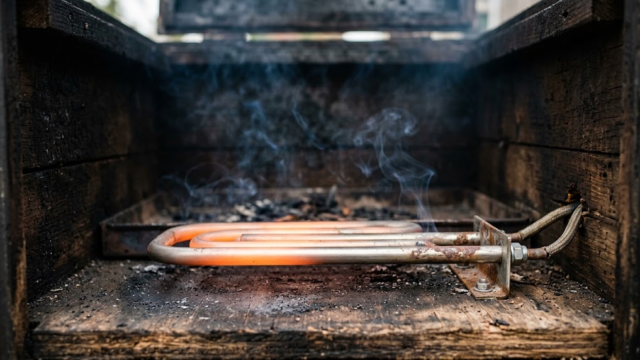
Which smoker heating element? Smoker heating element power: 2000 W or 3000 W
Which heating element for an electric smoker? Power matched to chamber volume and insulation, 230 V protection and power control with PID and SSR.
 Food smoking
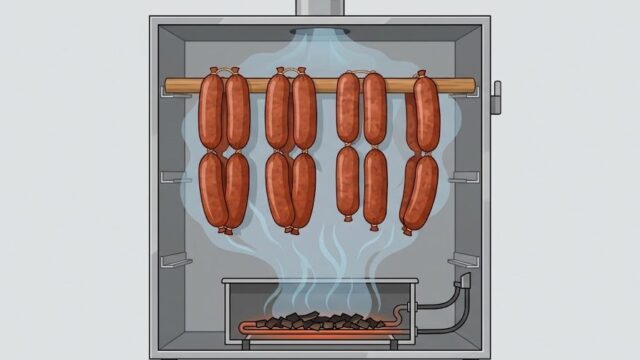
Smoking homemade sausage - from dry curing to cooking
Smoking homemade sausage step by step: dry curing, drying, choosing wood chips, a safe core temperature and the SAUSAGE program in the controller.
 Food smoking
Power cut while smoking: what to do when the smoke has been interrupted
Power cut while smoking? Check how long the food spent at 5-60 °C, when to carry on smoking and how resuming the process from the cloud works.