
Homemade advocaat (egg liqueur) - recipe and how to work out its strength

Contents
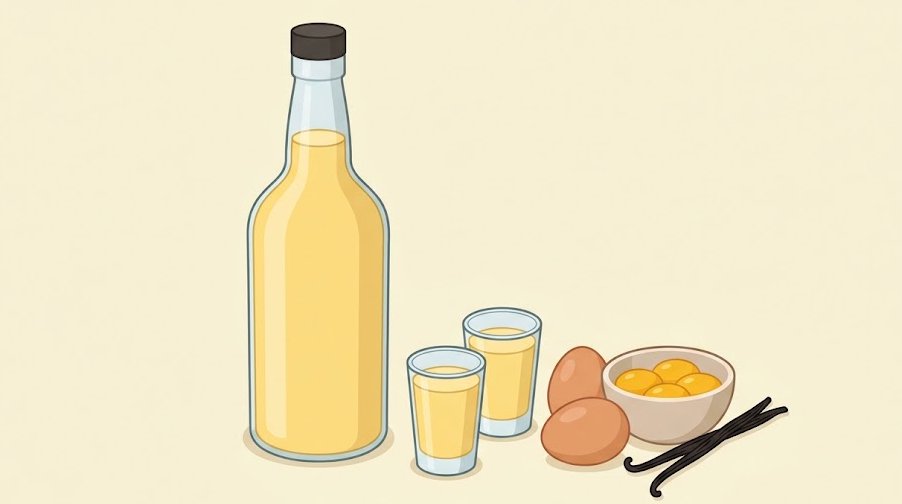
Homemade advocaat is made from egg yolks, sugar or sweetened condensed milk, milk and cream, vodka or rectified spirit, and vanilla. For 1 litre you need 6 egg yolks, 200 g icing sugar, 250 ml milk, 250 ml cream with 30% fat and 250 ml vodka at 40% ABV. This egg liqueur comes out at around 10% alcohol. Below you will find the quantities, how to pasteurise the yolks safely and the formula for working out the strength.
The recipe is simple, but two things decide the result. The first is temperature: yolks overheat easily, and instead of a smooth custard you end up with scrambled eggs. The second is strength, which is worth calculating from the quantities rather than guessing. That way every batch tastes the same.
Homemade advocaat - quantities for 1 litre
The basic version gives a thick, velvety liqueur with a gentle strength. All quantities are for roughly 1 litre of finished drink. The volumes do not add up perfectly, because sugar dissolves in the liquid and alcohol shrinks slightly when mixed with water. For home calculations, though, this level of accuracy is more than enough.
| Ingredient | Amount | Role in the liqueur |
|---|---|---|
| Yolks from fresh eggs | 6 (approx. 110 ml) | thickness, colour, flavour |
| Icing sugar | 200 g | sweetness, dissolves faster than granulated sugar |
| Milk | 250 ml | thins the mixture |
| Cream, 30% fat | 250 ml | creaminess |
| Vodka, 40% ABV | 250 ml | strength and keeping quality |
| Vanilla | 1 pod or 1 teaspoon of extract | aroma |
Instead of vodka you can use rectified spirit. In that case 105 ml of 95% spirit adds almost the same amount of pure alcohol as 250 ml of 40% vodka, i.e. about 100 ml. Make up the missing volume with milk, so the liqueur keeps the same strength and thickness. Advocaat is also often made with brandy: 250 ml of 40% brandy gives the same strength as vodka and adds a warmer, fruitier note. If you prefer to sweeten with condensed milk, that version is described further down.
Homemade advocaat step by step
The safest approach is to heat the yolk mixture straight away. That is why the recipe below includes pasteurisation over a water bath. It takes a dozen or so minutes longer, but the liqueur is then also suitable for people who avoid raw eggs.
- Separate the yolks from the whites. You will not need the whites, so you can freeze them for later.
- Beat the yolks with the icing sugar and the seeds from the vanilla pod until pale and fluffy.
- Pour in the milk and cream, then mix thoroughly.
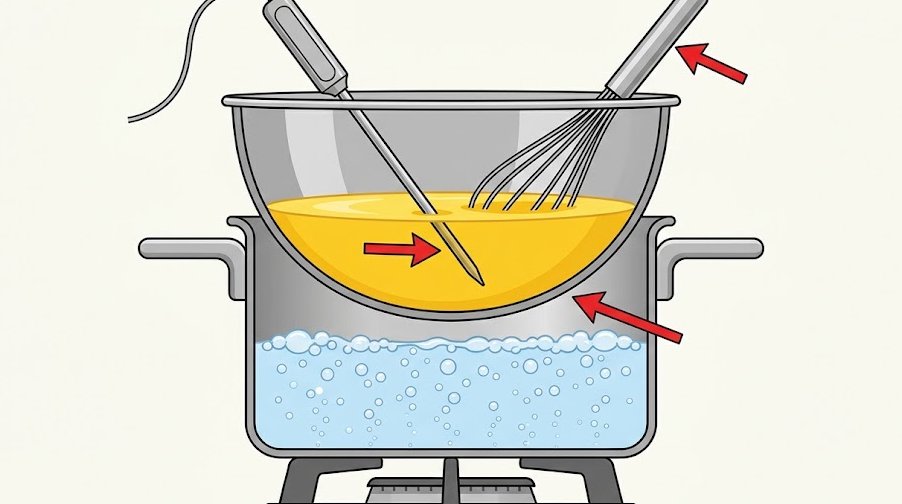
- Set the bowl over a pan of gently simmering water. The bottom of the bowl should not touch the water.
- Stir constantly and check the temperature. Heat the mixture to about 70 °C, until it has noticeably thickened.
- Take the bowl off the pan and cool the mixture, ideally in cold water, stirring all the time.
- Only once the mixture is cool, pour in the vodka or spirit in a thin stream while blending.
- Pour the liqueur into clean, sterilised bottles and put it in the fridge.
There is a good reason for adding the alcohol last. In a hot mixture some of the alcohol would evaporate, so the strength would end up lower than calculated. On top of that, cold spirit poured into hot yolks can make them curdle in places.
How to work out the strength of egg liqueur
You calculate the strength from the amount of pure alcohol you add to the mixture. Multiply the volume of vodka or spirit by its strength written as a decimal. Then divide the result by the volume of the whole liqueur and multiply by 100. This gives the alcohol by volume (ABV) of the finished drink.
An example from the basic recipe: 250 ml of 40% vodka contains 100 ml of pure alcohol. There is about 1000 ml of finished liqueur, so the strength is about 10%. If you add 250 ml of 95% spirit instead, you get almost 240 ml of pure alcohol and a liqueur of about 24%. That is a strong drink, but the flavour of the yolks and vanilla then fades noticeably.
You do not have to do the maths by hand. The fruit liqueur calculator works out the strength of the finished liqueur and the ratios of alcohol and sugar syrup. If you first want to turn spirit into vodka of a specific strength, use the alcohol dilution calculator. That way you know exactly how much water to add before the alcohol goes into the mixture.
Why you cannot measure the strength with an alcoholmeter
A standard alcoholmeter works on density, and sugar, fat and egg yolks all change that density. As a result, the reading in a thick liqueur is completely unreliable. With egg liqueur, calculating from the quantities is therefore the most reliable method.
Safety - raw yolks and storage
Raw eggs can carry Salmonella bacteria, so take this point seriously. The US Food and Drug Administration (FDA) recommends cooking egg dishes to 160 °F, i.e. about 71 °C. For dishes made with raw eggs, it advises using pasteurised eggs. You will find the details in the FDA guide to egg safety.
Alcohol is not a substitute for pasteurisation. At around 10% ABV there is no guarantee that it will kill the bacteria in the yolks. So choose fresh eggs with clean, undamaged shells and heat the mixture to about 70 °C. Measure the temperature in the centre of the mixture, for example with a kitchen thermometer with an NTC probe. Do not judge it by eye or by the steam, because a difference of a few degrees decides whether the mixture thickens or curdles.
How long homemade advocaat keeps in the fridge
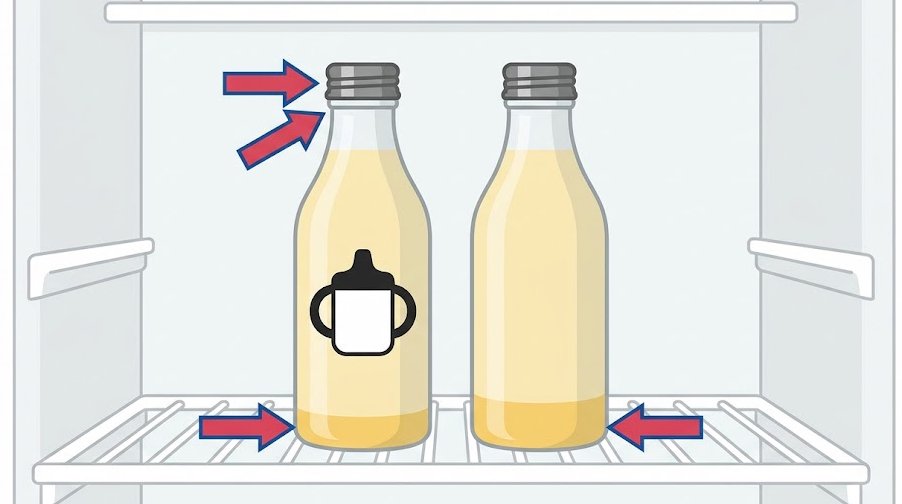
Store the liqueur in the fridge only, in a tightly sealed bottle. The FDA states that leftover cooked egg dishes should be used within 3-4 days. It is worth applying the same cautious rule to egg liqueur, especially the alcohol-free version. Always shake the bottle before pouring, because the thicker part settles at the bottom. If the smell or taste seems at all doubtful, pour the liqueur away.
Egg liqueur recipe variations
The basic recipe is easy to adapt. The key rules stay the same: pasteurise the yolks, cool the mixture and add the alcohol last. You can work out the strength of every version with the same formula.
Advocaat with condensed milk
Instead of sugar and milk, use a tin of sweetened condensed milk (about 400 g) and 250 ml cream. The liqueur comes out thicker, with a slight caramel note. Condensed milk is already sweet, so you do not add any sugar at all. Beat the yolks with the vanilla, combine them with the condensed milk and cream, then pasteurise as in the basic version.
Coffee version
Add 2-3 teaspoons of instant coffee or 50 ml of strong espresso to the warm mixture, before it is cooled. Espresso adds liquid, so reduce the milk by the same amount. This way the liqueur keeps its thickness. Coffee goes well with both vodka and dark rum.
Coconut version
Replace the cream with thick, full-fat coconut milk. Light rum suits the flavour, while the vanilla stays as it is. Coconut milk thickens more in the fridge than cream, so give the bottle a good shake before serving.
Alcohol-free advocaat for children
This is a separate drink, and it is best made in a separate bowl rather than poured off from the adults’ batch. You use the same yolks, sugar, milk, cream and vanilla, but leave out the alcohol entirely. Replace the volume of vodka with milk. Pasteurising to about 70 °C is essential here, because there is no alcohol to slow the growth of microorganisms even slightly.
Label the children’s version clearly on the bottle so that nobody mistakes it for the liqueur. Keep it in the fridge and drink it within 3-4 days. It tastes best chilled, with a pinch of cinnamon on top.
Frequently asked questions
How many egg yolks for a litre of advocaat?
For about 1 litre, 6 yolks are enough. More yolks give a thicker, eggier liqueur, while fewer let the flavour of the cream and alcohol dominate.
Vodka or rectified spirit for egg liqueur?
Both work well. 40% vodka gives a mild liqueur, while rectified spirit lets you raise the strength without thinning the mixture. You can work out the amount in the fruit liqueur calculator, so it is easy to match the strength to your own taste.
Why has the mixture curdled?
Usually because it overheated or the alcohol was added to the warm mixture too quickly. So stir constantly, keep an eye on the temperature and add the alcohol only after cooling. A slightly grainy mixture can often be rescued with a quick blitz in a blender.
Can you freeze homemade advocaat?
It is not a good idea, because the fat and yolks can separate after thawing. It is better to make a smaller batch and drink it fresh.
Related guides
 Distillation
The distillation process step by step: how distillation works and answers to common questions
The distillation process step by step: stages, fraction temperatures, heads, hearts and tails, the azeotrope and methanol - answers to common questions.
 Distillation
WiFi thermometer upgrade: how to turn a thermometer into a column controller
WiFi thermometer upgrade: the add-on module turns an EQUINOX thermometer into a column controller. What stays, what is added and when the RK.10 is better.
 Distillation
Reflux column thermometer: how many sensors and where to fit the probes
Reflux column thermometer: four probes (boiler, buffer, plate, condenser), what each shows, alarms and a pressure sensor with boiling point correction.